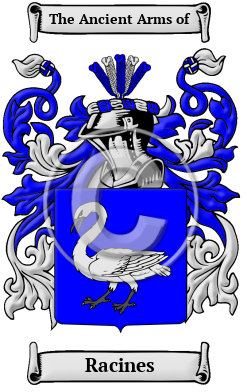
| ![Show Contents]() Racines History, Family Crest & Coats of Arms Racines History, Family Crest & Coats of Arms
- Origins Available:
France
Etymology of RacinesWhat does the name Racines mean? Of all the French names to come from that northwestern peninsula of France known as Brittany, Racines is one of the most ancient. The name is a result of the original family having lived in Brittany. The surname Racines was a also common occupational name for a grower of root vegetables. Interestingly, the name Racines was originally from the Old French word "racin," meaning "root." Early Origins of the Racines familyThe surname Racines was first found in Brittany (French: Bretagne) where they held a family seat in the seigneurie of Galisson, where they were members of the ancient aristocracy of that region. Étienne Racine, born in 1607, son of René and Marie (née Loysel), travelled from Normandy to Canada in the 17th century. After arriving in Quebec he married Marguerite Martin, daughter of Abraham and Marguerite (née Langlois), on 22nd May 1638. They remained together in Quebec until Marguerite's death at Château-Richer on 25th November 1679. Étienne passed away at Sainte-Anne-de-Beaupré on 24th April 1689. 1 Early History of the Racines familyThis web page shows only a small excerpt of our Racines research. Another 78 words (6 lines of text) covering the years 1639, 1692, 1699 and 1763 are included under the topic Early Racines History in all our PDF Extended History products and printed products wherever possible. Racines Spelling VariationsMost surnames have experienced slight spelling changes. A son may not chose to spell his name the same way that his father did. Many were errors, many deliberate. During the early development of the French language, a person usually gave his version, phonetically, to a scribe, a priest, or a recorder. Prefixes or suffixes varied. They were optional as they passed through the centuries, or were adopted by different branches to signify either a political or religious adherence. Hence, there a many spelling variations of the name Racines, including Racine, Racinne, Racina, Racinna, Racineux, Racinet, Racinnet, Racineau, Racinneau, Racineu and many more. Early Notables of the Racines familyMore information is included under the topic Early Racines Notables in all our PDF Extended History products and printed products wherever possible. Migration of the Racines familyImmigration to New France was slow; therefore, early marriage was desperately encouraged amongst the immigrants. The fur trade attracted migrants, both noble and commoner. 15,000 explorers left Montreal in the late 17th and 18th centuries. By 1675, there were 7000 French in Quebec. By the same year the Acadian presence in Nova Scotia, New Brunswick and Prince Edward Island had reached 500. In 1755, 10,000 French Acadians refused to take an oath of allegiance to England and were deported to Louisiana. The French founded Lower Canada, thus becoming one of the two great founding nations of Canada. The distinguished family name Racines has made significant contributions to the culture, arts, sciences and religion of France and New France. Amongst the settlers in North America with this distinguished name Racines were Etienne Racine who arrived in Quebec in 1637 from Normandy; Charles and Peter Racine settled in New York State in 1775; George Racine settled in Philadelphia, Pennsylvania in 1848.
- Olivier, Reginald L. Your Ancient Canadian Family Ties. Logan: The Everton Publishers, Inc., P.O. Box 368, 1972. Print
 |