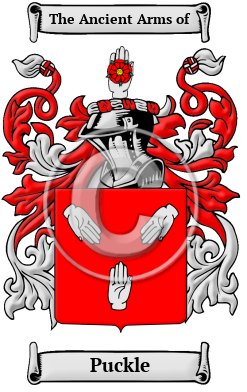
| ![Show Contents]() Puckle History, Family Crest & Coats of Arms Puckle History, Family Crest & Coats of Arms
- Origins Available:
England
Early Origins of the Puckle familyThe surname Puckle was first found in Sussex where they held a family seat as Lords of the Manor. After the Battle of Hastings in 1066, William, Duke of Normandy, having prevailed over King Harold, granted most of Britain to his many victorious Barons. It was not uncommon to find a Baron, or a Bishop, with 60 or more Lordships scattered throughout the country. These he gave to his sons, nephews and other junior lines of his family and they became known as under-tenants. They adopted the Norman system of surnames which identified the under-tenant with his holdings so as to distinguish him from the senior stem of the family. After many rebellious wars between his Barons, Duke William, commissioned a census of all England to determine in 1086, settling once and for all, who held which land. He called the census the Domesday Book, 1 indicating that those holders registered would hold the land until the end of time. Hence, conjecturally, the surname is descended from the tenant of the lands who was recorded in the Domesday Book census of 1086. Early History of the Puckle familyThis web page shows only a small excerpt of our Puckle research. Another 120 words (9 lines of text) covering the years 1200, 1275, 1510, 1562, 1588, 1600, 1633, 1656, 1661, 1667, 1690 and 1724 are included under the topic Early Puckle History in all our PDF Extended History products and printed products wherever possible. Puckle Spelling VariationsSpelling variations of this family name include: Puckle, Puckell, Puckel, Puchel, Puchell, Puckles and others. Early Notables of the Puckle family- James Puckle (1667-1724), an English inventor from London who developed what he called the Puckle Gun, a multi-shot rifle capable of firing nine rounds before being reloaded...
- James Puckle (1633-1690), who was himself third son of Samuel Puckle (1588-1661), a prominent citizen of Norwich, and mayor of that town in 16562...
| Puckle migration to New Zealand | + |
Emigration to New Zealand followed in the footsteps of the European explorers, such as Captain Cook (1769-70): first came sealers, whalers, missionaries, and traders. By 1838, the British New Zealand Company had begun buying land from the Maori tribes, and selling it to settlers, and, after the Treaty of Waitangi in 1840, many British families set out on the arduous six month journey from Britain to Aotearoa to start a new life. Early immigrants include: Puckle Settlers in New Zealand in the 19th Century- Rev. Edward Puckle, British settler travelling from London aboard the ship "Randolph" arriving in Lyttelton, Christchurch, South Island, New Zealand in September 1850 3
- Mrs. E. Puckle, British settler travelling from London aboard the ship "Randolph" arriving in Lyttelton, Christchurch, South Island, New Zealand in September 1850 3
- Mr. Edward Puckle, (b. 1835), aged 15, British settler travelling from London aboard the ship "Randolph" arriving in Lyttelton, Christchurch, South Island, New Zealand in September 1850 3
- Miss Summers Puckle, (b. 1838), aged 12, British settler travelling from London aboard the ship "Randolph" arriving in Lyttelton, Christchurch, South Island, New Zealand in September 1850 3
- Miss Sidney Puckle, (b. 1840), aged 10, British settler travelling from London aboard the ship "Randolph" arriving in Lyttelton, Christchurch, South Island, New Zealand in September 1850 3
- ... (More are available in all our PDF Extended History products and printed products wherever possible.)
- Williams, Dr Ann. And G.H. Martin, Eds., Domesday Book A Complete Translation. London: Penguin, 1992. Print. (ISBN 0-141-00523-8)
- Smith, George (ed), Dictionary of National Biography. London: Smith, Elder & Co., 1885-1900. Print
- New Zealand Yesteryears Passenger Lists 1800 to 1900 (Retrieved 26th March 2019). Retrieved from http://www.yesteryears.co.nz/shipping/passlist.html
 |