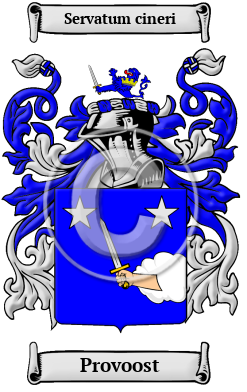
| ![Show Contents]() Provoost History, Family Crest & Coats of Arms Provoost History, Family Crest & Coats of Arms
- Origins Available:
England
Early Origins of the Provoost familyThe surname Provoost was first found in Rutland where they held a family seat as Lords of the Manor. After the Battle of Hastings in 1066, William, Duke of Normandy, having prevailed over King Harold, granted most of Britain to his many victorious Barons. It was not uncommon to find a Baron, or a Bishop, with 60 or more Lordships scattered throughout the country. These he gave to his sons, nephews and other junior lines of his family and they became known as under-tenants. They adopted the Norman system of surnames which identified the under-tenant with his holdings so as to distinguish him from the senior stem of the family. After many rebellious wars between his Barons, Duke William, commissioned a census of all England to determine in 1086, settling once and for all, who held which land. He called the census the Domesday Book, 1 indicating that those holders registered would hold the land until the end of time. Hence, conjecturally, the surname is descended from the tenant of the lands who was recorded in the Domesday Book census of 1086. This notable family, Prevost de la Croix, held a family seat in Poinou. They held the fiefs of Sonnotte, Prejailly, Villette, Bodes, le Pesse, and Bouteliere. Early History of the Provoost familyThis web page shows only a small excerpt of our Provoost research. Another 73 words (5 lines of text) covering the year 1410 is included under the topic Early Provoost History in all our PDF Extended History products and printed products wherever possible. Provoost Spelling VariationsSpelling variations of this family name include: Prevost, Provost, le Prevost, le Provost, Provest, Prevest and many more. Early Notables of the Provoost familyMore information is included under the topic Early Provoost Notables in all our PDF Extended History products and printed products wherever possible.
| Provoost migration to the United States | + |
Provoost Settlers in United States in the 17th Century- David Provoost, who arrived in New York in 1624 2
- Willem Provoost, who landed in New Netherland(s) in 1624 2
The motto was originally a war cry or slogan. Mottoes first began to be shown with arms in the 14th and 15th centuries, but were not in general use until the 17th century. Thus the oldest coats of arms generally do not include a motto. Mottoes seldom form part of the grant of arms: Under most heraldic authorities, a motto is an optional component of the coat of arms, and can be added to or changed at will; many families have chosen not to display a motto.
Motto: Servatum cineri
Motto Translation: Faith kept with the dead
- Williams, Dr Ann. And G.H. Martin, Eds., Domesday Book A Complete Translation. London: Penguin, 1992. Print. (ISBN 0-141-00523-8)
- Filby, P. William, Meyer, Mary K., Passenger and immigration lists index : a guide to published arrival records of about 500,000 passengers who came to the United States and Canada in the seventeenth, eighteenth, and nineteenth centuries. 1982-1985 Cumulated Supplements in Four Volumes Detroit, Mich. : Gale Research Co., 1985, Print (ISBN 0-8103-1795-8)
 |