| ![Show Contents]() Porten History, Family Crest & Coats of Arms Porten History, Family Crest & Coats of Arms
- Origins Available:
England
Etymology of PortenWhat does the name Porten mean? The ancestry of the name Porten dates from the ancient Anglo-Saxon culture of Britain. It comes from when the family lived in one of many places called Boughton throughout England. Settlements named Boughton were found in Huntingdonshire, Lincolnshire, Nottinghamshire, and Northamptonshire. Great Boughton is found in Cheshire, and Kent was home to settlements called Boughton Aluph, Boughton Malherbe, Boughton Monchelsea, and Boughton under Blean. Early Origins of the Porten familyThe surname Porten was first found in Warwickshire, where this "family of good antiquity, traced to Robert de Boreton, grandfather of William, who lived in the reign of Edward III. " 1 "Downton Hall [in Downton, Shropshire], the seat of Sir William Rouse Boughton, Bart., to whom the whole property belongs, is a handsome mansion, approached by a beautiful avenue two miles in length, on a gradual ascent, from which the scenery is extensive, romantic, and mountainous, embracing the Titterstone and the Clee hills." 2 One of the earliest records of the family was Joan Boughton (d. 1494), the English martyr, who "was an old widow of eighty years or more, who held certain of Wycliffe's opinions. She was said to be the mother of a lady named Young, who was suspected of the like doctrines. She was burnt at Smithfield 28 April 1494. " 3 Early History of the Porten familyThis web page shows only a small excerpt of our Porten research. Another 204 words (15 lines of text) covering the years 1600, 1628, 1632, 1656, 1663, 1680, 1683, 1689, 1716, 1722, 1747, 1760, 1780, 1791, 1794, 1821, 1893 and 1963 are included under the topic Early Porten History in all our PDF Extended History products and printed products wherever possible. Porten Spelling VariationsSpelling variations in names were a common occurrence before English spelling was standardized a few hundred years ago. In the Middle Ages, even the literate spelled their names differently as the English language incorporated elements of French, Latin, and other European languages. Many variations of the name Porten have been found, including Boughton, Bourton, Borton, Boughten, Bourten, Borten, Bouton, Broughton, Portan, Porten and many more. Early Notables of the Porten familySir William Boughton, 1st Baronet (1600-1656) of Lawford in the County of Warwick; Sir Edward Boughton, 2nd Baronet (1628-1680); Sir William Boughton, 3rd Baronet (1632-1683); Sir William Boughton, 4th Baronet (1663-1716)...
Another 31 words (2 lines of text) are included under the topic Early Porten Notables in all our PDF Extended History products and printed products wherever possible.
| Porten migration to the United States | + |
Families began migrating abroad in enormous numbers because of the political and religious discontent in England. Often faced with persecution and starvation in England, the possibilities of the New World attracted many English people. Although the ocean trips took many lives, those who did get to North America were instrumental in building the necessary groundwork for what would become for new powerful nations. Some of the first immigrants to cross the Atlantic and come to North America bore the name Porten, or a variant listed above:
Porten Settlers in United States in the 17th Century- Mary Porten, who landed in Virginia in 1650 4
Porten Settlers in United States in the 19th Century- Launcelot Porten, who arrived in Texas in 1850-1906 4
| Contemporary Notables of the name Porten (post 1700) | + |
- Charles S. Vander Porten, American politician, Socialist Labor Candidate for U.S. Representative from New York 5th District, 1900; Candidate for New York State Assembly, 1901, 1909 5
- Paula L. Porten, American Republican politician, Candidate for Massachusetts State House of Representatives Fourteenth Essex District, 2002 6
- Matt Porten, American Democratic Party politician, Delegate to Democratic National Convention from Illinois, 1940, 1944 (alternate) 7
- Sir Stanier Porten (d. 1789), English government official, the only son of James Porten, merchant of London, of Huguenot descent
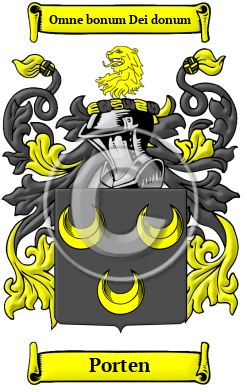
The motto was originally a war cry or slogan. Mottoes first began to be shown with arms in the 14th and 15th centuries, but were not in general use until the 17th century. Thus the oldest coats of arms generally do not include a motto. Mottoes seldom form part of the grant of arms: Under most heraldic authorities, a motto is an optional component of the coat of arms, and can be added to or changed at will; many families have chosen not to display a motto.
Motto: Omne bonum Dei donum
Motto Translation: Every good is the gift of God.
- Shirley, Evelyn Philip, The Noble and Gentle Men of England; The Arms and Descents. Westminster: John Bower Nichols and Sons, 1866, Print.
- Lewis, Samuel, A Topographical Dictionary of England. Institute of Historical Research, 1848, Print.
- Smith, George (ed), Dictionary of National Biography. London: Smith, Elder & Co., 1885-1900. Print
- Filby, P. William, Meyer, Mary K., Passenger and immigration lists index : a guide to published arrival records of about 500,000 passengers who came to the United States and Canada in the seventeenth, eighteenth, and nineteenth centuries. 1982-1985 Cumulated Supplements in Four Volumes Detroit, Mich. : Gale Research Co., 1985, Print (ISBN 0-8103-1795-8)
- The Political Graveyard: Alphabetical Name Index. (Retrieved 2016, February 2) . Retrieved from http://politicalgraveyard.com/alpha/index.html
- The Political Graveyard: Alphabetical Name Index. (Retrieved 2016, January 22) . Retrieved from http://politicalgraveyard.com/alpha/index.html
 |