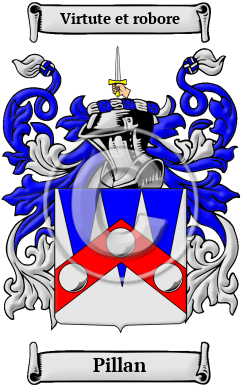
| ![Show Contents]() Pillan History, Family Crest & Coats of Arms Pillan History, Family Crest & Coats of Arms
Etymology of PillanWhat does the name Pillan mean? Pillan is a name that was brought to England by the ancestors of the Pillan family when they migrated to the region after the Norman Conquest in 1066. The Pillan family lived in Yorkshire. The name was a reference to Pilling Manor, where the family lived. This stately residence is in the parish of Tankersley, nine miles from Sheffield, in the West Riding of Yorkshire, and now belongs to the distinguished Lord Wharncliffe. Early Origins of the Pillan familyThe surname Pillan was first found in Lancashire at Pilling, a chapelry, in the parish and union of Garstang, hundred of Amounderness. " 'Pilyn' was possessed by the abbey of Cockersand until the Dissolution, when Henry VIII. granted lands here." 1 2 Early records of the family are scarce as the first record found was Adam Pilling who was listed in the Subsidy Rolls of Suffolk in 1283. A few years later, Emma Pylyng was listed in the Subsidy Rolls of Sussex in 1296. 3 Early History of the Pillan familyThis web page shows only a small excerpt of our Pillan research. Another 96 words (7 lines of text) are included under the topic Early Pillan History in all our PDF Extended History products and printed products wherever possible. Pillan Spelling VariationsSpelling variations in names were a common occurrence in the eras before English spelling was standardized a few hundred years ago. In the Middle Ages, even the literate regularly changed the spellings of their names as the English language incorporated elements of French, Latin, and other European languages. Many variations of the name Pillan have been found, including Pilling, Pillans, Pilland, Pillings and others. Early Notables of the Pillan familyMore information is included under the topic Early Pillan Notables in all our PDF Extended History products and printed products wherever possible. Migration of the Pillan family to IrelandSome of the Pillan family moved to Ireland, but this topic is not covered in this excerpt. More information about their life in Ireland is included in all our PDF Extended History products and printed products wherever possible. Migration of the Pillan familyFor many English families, the social climate in England was oppressive and lacked opportunity for change. For such families, the shores of Ireland, Australia, and the New World beckoned. They left their homeland at great expense in ships that were overcrowded and full of disease. Many arrived after the long voyage sick, starving, and without a penny. But even those were greeted with greater opportunity than they could have experienced back home. Numerous English settlers who arrived in the United States and Canada at this time went on to make important contributions to the developing cultures of those countries. Many of those families went on to make significant contributions to the rapidly developing colonies in which they settled. Early North American records indicate many people bearing the name Pillan were among those contributors: William Pilling, a bonded passenger, who came to America in 1720; Simon Pillanus, who arrived in Philadelphia in 1748; Jonathan Pilling, a bonded passenger, who arrived in America in 1772.
The motto was originally a war cry or slogan. Mottoes first began to be shown with arms in the 14th and 15th centuries, but were not in general use until the 17th century. Thus the oldest coats of arms generally do not include a motto. Mottoes seldom form part of the grant of arms: Under most heraldic authorities, a motto is an optional component of the coat of arms, and can be added to or changed at will; many families have chosen not to display a motto.
Motto: Virtute et robore
Motto Translation: By virtue and strength.
- Lewis, Samuel, A Topographical Dictionary of England. Institute of Historical Research, 1848, Print.
- Guppy, Henry Brougham, Homes of Family Names in Great Britain. 1890. Print.
- Reaney, P.H and R.M. Wilson, A Dictionary of English Surnames. London: Routledge, 1991. Print. (ISBN 0-415-05737-X)
 |