| ![Show Contents]() Pilan History, Family Crest & Coats of Arms Pilan History, Family Crest & Coats of Arms
Etymology of PilanWhat does the name Pilan mean? The name Pilan arrived in England after the Norman Conquest of 1066. The Pilan family lived in Yorkshire. The name was a reference to Pilling Manor, where the family lived. This stately residence is in the parish of Tankersley, nine miles from Sheffield, in the West Riding of Yorkshire, and now belongs to the distinguished Lord Wharncliffe. Early Origins of the Pilan familyThe surname Pilan was first found in Lancashire at Pilling, a chapelry, in the parish and union of Garstang, hundred of Amounderness. " 'Pilyn' was possessed by the abbey of Cockersand until the Dissolution, when Henry VIII. granted lands here." 1 2 Early records of the family are scarce as the first record found was Adam Pilling who was listed in the Subsidy Rolls of Suffolk in 1283. A few years later, Emma Pylyng was listed in the Subsidy Rolls of Sussex in 1296. 3 Early History of the Pilan familyThis web page shows only a small excerpt of our Pilan research. Another 96 words (7 lines of text) are included under the topic Early Pilan History in all our PDF Extended History products and printed products wherever possible. Pilan Spelling VariationsAnglo-Norman names are characterized by a multitude of spelling variations. When the Normans became the ruling people of England in the 11th century, they introduced a new language into a society where the main languages of Old and later Middle English had no definite spelling rules. These languages were more often spoken than written, so they blended freely with one another. Contributing to this mixing of tongues was the fact that medieval scribes spelled words according to sound, ensuring that a person's name would appear differently in nearly every document in which it was recorded. The name has been spelled Pilling, Pillans, Pilland, Pillings and others. Early Notables of the Pilan familyMore information is included under the topic Early Pilan Notables in all our PDF Extended History products and printed products wherever possible. Migration of the Pilan family to IrelandSome of the Pilan family moved to Ireland, but this topic is not covered in this excerpt. More information about their life in Ireland is included in all our PDF Extended History products and printed products wherever possible. Migration of the Pilan familyFor many English families, the political and religious disarray that plagued their homeland made the frontiers of the New World an attractive prospect. Thousands migrated, aboard cramped disease-ridden ships. They arrived sick, poor, and hungry, but were welcomed in many cases with far greater opportunity than at home in England. Many of these hardy settlers went on to make important contributions to the emerging nations in which they landed. Among early immigrants bearing the name Pilan or a variant listed above were: William Pilling, a bonded passenger, who came to America in 1720; Simon Pillanus, who arrived in Philadelphia in 1748; Jonathan Pilling, a bonded passenger, who arrived in America in 1772.
| Contemporary Notables of the name Pilan (post 1700) | + |
- Ildiko Pilan, Swedish scientist at the University of Gothenburg
- Fernando Cesar Pilan, Professor de Filosofia, Instituto Federal de São Paulo
- Luisa Pilan, scientist at the University Politehnica of Bucharest
The motto was originally a war cry or slogan. Mottoes first began to be shown with arms in the 14th and 15th centuries, but were not in general use until the 17th century. Thus the oldest coats of arms generally do not include a motto. Mottoes seldom form part of the grant of arms: Under most heraldic authorities, a motto is an optional component of the coat of arms, and can be added to or changed at will; many families have chosen not to display a motto.
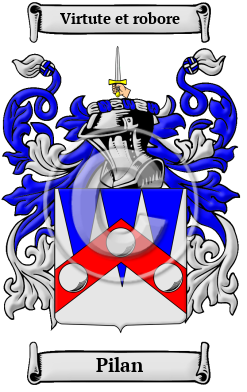
Motto: Virtute et robore
Motto Translation: By virtue and strength.
- Lewis, Samuel, A Topographical Dictionary of England. Institute of Historical Research, 1848, Print.
- Guppy, Henry Brougham, Homes of Family Names in Great Britain. 1890. Print.
- Reaney, P.H and R.M. Wilson, A Dictionary of English Surnames. London: Routledge, 1991. Print. (ISBN 0-415-05737-X)
 |