
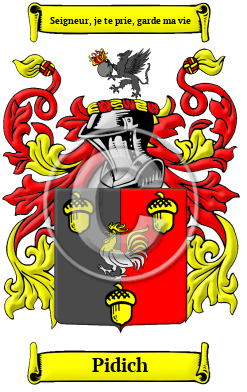
Show ContentsPidich History, Family Crest & Coats of Arms

Etymology of Pidich

What does the name Pidich mean?

Pidich is one of the oldest family names to come from the Anglo-Saxon tribes of Britain. It is derived from Paeda the first Christian King of Mercia. The surname Pidich referred to the son of Paeda which belongs to the category of patronymic surnames. In Old English, patronyms were formed by adding a variety of suffixes to personal names, which changed over time and from place to place. For example, after the Norman Conquest, sunu and sune, which meant son, were the most common patronymic suffixes. In the 12th and 13th centuries, the most common patronymic names included the word filius, which meant son. By the 14th century, the suffix son had replaced these earlier versions. Surnames that were formed with filius or son were more common in the north of England and it was here that the number of individuals without surnames was greatest at this time.

Early Origins of the Pidich family

The surname Pidich was first found in Somerset where they held a family seat from early times and their first records appeared on the early census rolls taken by the early Kings of Britain to determine the rate of taxation of their subjects.

Early History of the Pidich family

This web page shows only a small excerpt of our Pidich research. Another 85 words (6 lines of text) are included under the topic Early Pidich History in all our PDF Extended History products and printed products wherever possible.

Pidich Spelling Variations

Only recently has spelling become standardized in the English language. As the English language evolved in the Middle Ages, the spelling of names changed also. The name Pidich has undergone many spelling variations, including Pidcock, Piddock, Pidocock, Pitcock, Pittock and others.

Early Notables of the Pidich family

More information is included under the topic Early Pidich Notables in all our PDF Extended History products and printed products wherever possible.

Migration of the Pidich family

To escape the unstable social climate in England of this time, many families boarded ships for the New World with the hope of finding land, opportunity, and greater religious and political freedom. Although the voyages were expensive, crowded, and difficult, those families that arrived often found greater opportunities and freedoms than they could have experienced at home. Many of those families went on to make significant contributions to the rapidly developing colonies in which they settled. Early North American records indicate many people bearing the name Pidich were among those contributors: Thomas Piddock, who arrived in Maine in 1624; George Pidcock, who settled in New England in 1657; William Piddock settled in Virginia in 1679; Elizabeth Piddock, who came to Maryland in 1684.


The Pidich Motto +

The motto was originally a war cry or slogan. Mottoes first began to be shown with arms in the 14th and 15th centuries, but were not in general use until the 17th century. Thus the oldest coats of arms generally do not include a motto. Mottoes seldom form part of the grant of arms: Under most heraldic authorities, a motto is an optional component of the coat of arms, and can be added to or changed at will; many families have chosen not to display a motto.

Motto: Seigneur, je te prie, garde ma vie
Motto Translation: Lord, I beseech thee, save my life.


Houseofnames.com on Facebook