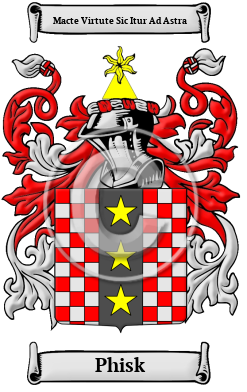
| ![Show Contents]() Phisk History, Family Crest & Coats of Arms Phisk History, Family Crest & Coats of Arms
- Origins Available:
England
Etymology of PhiskWhat does the name Phisk mean? The name Phisk was a nickname "the fish" for someone who was a fisherman or someone who sold fish from the Icelandic "fiskr" or the Danish "fish." 1 The name in Middle English was spelt fiske or fyske and was typically a northern England from of the word "fish." 2 Early Origins of the Phisk familyThe surname Phisk was first found in Norfolk where "Fisc occurs as a personal name in the Domesday Book of 1086." 3 4 5 Later, Ernis Fish was listed in the Assize Rolls for Lincolnshire in 1202 and in Suffolk, Daniel Fisc was listed there in 1208. The Pipe Rolls of Northumberland included Robert Fisk in 1230. In Cornwall, Robert le Fysch was found there in 1297. 4 "The Fiskes or Fisks are probably connected with the Fiskes of the parish of Cratling in the 17th century: a monument to one of the family in Cratling church bore the date of 1640 Rattlesden [Suffolk] was the home of an ancient family of Fiske, owning much property in the county last century." 6 Early History of the Phisk familyThis web page shows only a small excerpt of our Phisk research. Another 305 words (22 lines of text) covering the years 1086, 1519, 1637, 1643, 1796, 1818, 1819, 1827, 1846, 1872, 1884 and 1902 are included under the topic Early Phisk History in all our PDF Extended History products and printed products wherever possible. Phisk Spelling VariationsOnly recently has spelling become standardized in the English language. As the English language evolved in the Middle Ages, the spelling of names changed also. The name Phisk has undergone many spelling variations, including Fisk, Ffiske, Fiske, Fisc and others. Early Notables of the Phisk familyWilliam Fisk (1796-1872), the English painter, born in 1796 at Thorpe-le-Soken, Essex, "the son of a yeoman farmer at Can Hall in that county, of a family which boasted of some antiquity, dating back to the days of Henry IV. Drawing very early became Fisk's favourite occupation, but his inclination to art was discouraged by his father, who sent him to school at Colchester, and at nineteen years of age placed him in a mercantile house in London. In this uncongenial profession Fisk remained for ten years, though he never neglected his artistic...
Another 92 words (7 lines of text) are included under the topic Early Phisk Notables in all our PDF Extended History products and printed products wherever possible. Migration of the Phisk familyTo escape the unstable social climate in England of this time, many families boarded ships for the New World with the hope of finding land, opportunity, and greater religious and political freedom. Although the voyages were expensive, crowded, and difficult, those families that arrived often found greater opportunities and freedoms than they could have experienced at home. Many of those families went on to make significant contributions to the rapidly developing colonies in which they settled. Early North American records indicate many people bearing the name Phisk were among those contributors: John Fiske, who arrived in Salem Massachusetts in 1637; David Fiske settled in Cambridge Massachusetts in 1640; Caspar Fisk settled in Delaware in 1693.
The motto was originally a war cry or slogan. Mottoes first began to be shown with arms in the 14th and 15th centuries, but were not in general use until the 17th century. Thus the oldest coats of arms generally do not include a motto. Mottoes seldom form part of the grant of arms: Under most heraldic authorities, a motto is an optional component of the coat of arms, and can be added to or changed at will; many families have chosen not to display a motto.
Motto: Macte Virtute Sic Itur Ad Astra
Motto Translation: So to the stars we go.
- Bardsley, C.W, A Dictionary of English and Welsh Surnames: With Special American Instances. Wiltshire: Heraldry Today, 1901. Print. (ISBN 0-900455-44-6)
- Harrison, Henry, Surnames of the United Kingdom: A Concise Etymological Dictionary Baltimore: Geneological Publishing Company, 2013. Print
- Williams, Dr Ann. And G.H. Martin, Eds., Domesday Book A Complete Translation. London: Penguin, 1992. Print. (ISBN 0-141-00523-8)
- Reaney, P.H and R.M. Wilson, A Dictionary of English Surnames. London: Routledge, 1991. Print. (ISBN 0-415-05737-X)
- Barber, Henry, British Family Names London: Elliot Stock, 62 Paternoster Row, 1894. Print.
- Guppy, Henry Brougham, Homes of Family Names in Great Britain. 1890. Print.
 |