| ![Show Contents]() Penningtons History, Family Crest & Coats of Arms Penningtons History, Family Crest & Coats of Arms
Etymology of PenningtonsWhat does the name Penningtons mean? The Anglo-Saxon name Penningtons comes from the family having resided in Lancashire at Pennington. Interestingly, two sources claim the name literally means "farmstead paying a penny rent." 1 2 Early Origins of the Penningtons familyThe surname Penningtons was first found in Lancashire, England at Pennington, a parish, in the union of Ulverston, hundred of Lonsdale north of the Sands. "This place, which in Domesday Book is styled 'Pennigetun,' belonged to a local family, one of whom, Gamel de Pennington, was a very considerable person at the time of the Conquest. 3 From him descended Sir John Pennington, who commanded the left wing of the army in an expedition into Scotland under the Earl of Northumberland," 4 By the time of Henry II, some of the family had branched to Muncaster in Cumberland (now part of Cumbria) and it was here that King Henry VI was concealed by Sir John Pennington in his flight from his enemies. 5 "The ancient and influential knightly family of the Penningtons were lords of Pennington from the 11th century to the reign of Henry VI., a monarch who numbered Sir John de Pennington amongst his most trusted adherents. In the first quarter of the 17th century there was a gentle family of the name at Mitton Magna. The name is also established in Cheshire." 6 Early History of the Penningtons familyThis web page shows only a small excerpt of our Penningtons research. Another 89 words (6 lines of text) covering the years 1552, 1558, 1565, 1584, 1599, 1616, 1623, 1640, 1642, 1646, 1653, 1655, 1661, 1676, 1679, 1682, 1730 and 1783 are included under the topic Early Penningtons History in all our PDF Extended History products and printed products wherever possible. Penningtons Spelling VariationsPenningtons has been spelled many different ways. Before English spelling became standardized over the last few hundred years, spelling variations in names were a common occurrence. As the English language changed in the Middle Ages, absorbing pieces of Latin and French, as well as other languages, the spelling of people's names also changed considerably, even over a single lifetime. Spelling variants included: Pennington, Penington and others. Early Notables of the Penningtons familyWilliam Penington, High Sheriff of Cumberland in 1552, 1558 and 1565; Joseph Pennington of Muncaster Castle, High Sheriff of Cumberland in 1599; and Sir William Pennington (1655-1730), 1st Baronet.
Sir Isaac Penington (1584-1661), was an English politician who sat in the House of Commons from 1640 to 1653, Lord Mayor of London in 1642 and a prominent member of Oliver Cromwell's government. His son Isaac Penington (1616-1679), was one of...
Another 68 words (5 lines of text) are included under the topic Early Penningtons Notables in all our PDF Extended History products and printed products wherever possible. Migration of the Penningtons familyIn an attempt to escape the chaos experienced in England, many English families boarded overcrowded and diseased ships sailing for the shores of North America and other British colonies. Those families hardy enough, and lucky enough, to make the passage intact were rewarded with land and a social environment less prone to religious and political persecution. Many of these families became important contributors to the young colonies in which they settled. Early immigration and passenger lists have documented some of the first Penningtonss to arrive on North American shores: John Penington, who settled at St. Christopher in 1633; Charles Penington, who arrived in Virginia in 1695; William Penington, who arrived in Virginia in 1652.
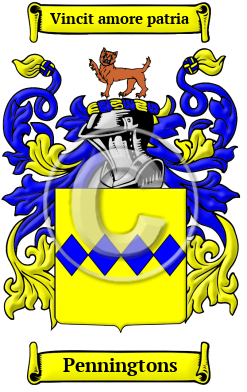
The motto was originally a war cry or slogan. Mottoes first began to be shown with arms in the 14th and 15th centuries, but were not in general use until the 17th century. Thus the oldest coats of arms generally do not include a motto. Mottoes seldom form part of the grant of arms: Under most heraldic authorities, a motto is an optional component of the coat of arms, and can be added to or changed at will; many families have chosen not to display a motto.
Motto: Vincit amore patria
Motto Translation: My beloved country will conquer.
- Mills, A.D., Dictionary of English Place-Names. Oxford: Oxford University Press, 1991. Print. (ISBN 0-19-869156-4)
- Smith, Eldson Coles, New Dictionary of American Family Names New York: Harper & Row, 1956. Print
- Lower, Mark Anthony, Patronymica Britannica, A Dictionary of Family Names of the United Kingdom. London: John Russel Smith, 1860. Print.
- Lewis, Samuel, A Topographical Dictionary of England. Institute of Historical Research, 1848, Print.
- Shirley, Evelyn Philip, The Noble and Gentle Men of England; The Arms and Descents. Westminster: John Bower Nichols and Sons, 1866, Print.
- Guppy, Henry Brougham, Homes of Family Names in Great Britain. 1890. Print.
 |