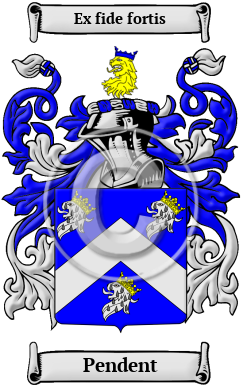
| ![Show Contents]() Pendent History, Family Crest & Coats of Arms Pendent History, Family Crest & Coats of Arms
- Origins Available:
England
Etymology of PendentWhat does the name Pendent mean? The name Pendent is part of the ancient legacy of the Anglo-Saxon tribes of Britain. The name was taken on by someone who worked as a person who worked as the Pinder which referred to the individual who impounded stray cattle. During the Middle Ages there was rampant theft of livestock, which made the Pinder a very important member of the community. 1 The variant Pounder was used interchangeably with Pinder. 2 Early Origins of the Pendent familyThe surname Pendent was first found in Nottinghamshire and Lincolnshire where the name has appeared "for six centuries, and occurs in both counties as Le Pinder in the reign of Edward I." 3 "The Pindar (or Pinder) of Wakefield (George a Green) is the subject of one of the Robin Hood ballads. " "She doth not only think of lusty Robin Hood, But of his merry man, the Pindar of the Town Of Wakefield, George a Greene.- Drayton, Poly-Olbion, xxviii, 70-2." 2 Interestingly, the Hundredorum Rolls had only two entries for the family and both were in the aforementioned counties: Hugh le Pinder, Lincolnshire; and Walter le Pinder, Nottinghamshire. 1 The Excerpta e Rotulis Finium in Turri Londinensi listed John le Pindere while the Writs of Parliament c. 1300 listed Henry le Pynder Early History of the Pendent familyThis web page shows only a small excerpt of our Pendent research. Another 132 words (9 lines of text) covering the years 1538, 1565, 1650, 1680, 1693, 1694, 1705 and 1749 are included under the topic Early Pendent History in all our PDF Extended History products and printed products wherever possible. Pendent Spelling VariationsBefore English spelling was standardized a few hundred years ago, spelling variations of names were a common occurrence. Elements of Latin, French and other languages became incorporated into English through the Middle Ages, and name spellings changed even among the literate. The variations of the surname Pendent include Pinder, Pynder, Pyndar, Pendar, Pindar, Pinner, Pinter, Pender and many more. Early Notables of the Pendent familySir Paul Pindar (c. 1565-1650), English diplomat, born at Wellingborough, Northamptonshire. "The family is said to have been long resident in Wellingborough." 4
Sir Peter Pindar, of Idinshaw in the County of Chester, 1st...
Another 33 words (2 lines of text) are included under the topic Early Pendent Notables in all our PDF Extended History products and printed products wherever possible. Migration of the Pendent familyA great wave of immigration to the New World was the result of the enormous political and religious disarray that struck England at that time. Families left for the New World in extremely large numbers. The long journey was the end of many immigrants and many more arrived sick and starving. Still, those who made it were rewarded with an opportunity far greater than they had known at home in England. These emigrant families went on to make significant contributions to these emerging colonies in which they settled. Some of the first North American settlers carried this name or one of its variants: James Pinner who settled in Virginia in 1643; John Pinner settled in Barbados in 1669; Catherine and Joanna Pinder settled in New England in 1635; with their parents.
The motto was originally a war cry or slogan. Mottoes first began to be shown with arms in the 14th and 15th centuries, but were not in general use until the 17th century. Thus the oldest coats of arms generally do not include a motto. Mottoes seldom form part of the grant of arms: Under most heraldic authorities, a motto is an optional component of the coat of arms, and can be added to or changed at will; many families have chosen not to display a motto.
Motto: Ex fide fortis
Motto Translation: Strong though faith.
- Bardsley, C.W, A Dictionary of English and Welsh Surnames: With Special American Instances. Wiltshire: Heraldry Today, 1901. Print. (ISBN 0-900455-44-6)
- Harrison, Henry, Surnames of the United Kingdom: A Concise Etymological Dictionary Baltimore: Geneological Publishing Company, 2013. Print
- Guppy, Henry Brougham, Homes of Family Names in Great Britain. 1890. Print.
- Smith, George (ed), Dictionary of National Biography. London: Smith, Elder & Co., 1885-1900. Print
 |