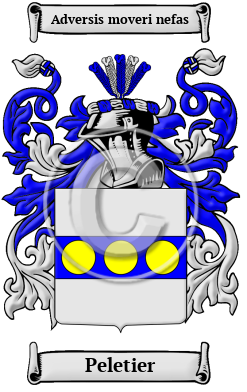
| ![Show Contents]() Peletier History, Family Crest & Coats of Arms Peletier History, Family Crest & Coats of Arms
Etymology of PeletierWhat does the name Peletier mean? The French family name Peletier dates back to the Middle Ages. It was a Norman name given to a furrier. Looking back even further, we found the name was originally derived from the Old French word "pellet", meaning "animal skin", and was used to indicate a person in the trade of removing and selling the skins of animals. Early Origins of the Peletier familyThe surname Peletier was first found in Normandy (French: Normandie), the former Duchy of Normandy, where they held a family seat in the honors of Martinville, Molande, Ravinieres and Houssaye. After the revolution this aristocratic family were made Barons of the Empire in the early 19th century. They also appeared in l'île-de-France, and Lyonnais and Toulouse to the south of France. Notable was Pierre Pelletier, French chemist, 1788-1842, who discovered, together with Caventou, the sulphate of quinine, and Jean Charles Paltier, French Physician 1785-1845. Guillaume Pelletier, born in 1598 in Orne, France, came to Canada with his wife, Michelle (née Mabille). They married in France on 12th February 1619 and had two sons before travelling to the New World together. Guillaume worked in Quebec as a carpenter and had six more children with Michelle. Jean, their oldest son, was born on 12th June 1627. He married Anne Langlois in Quebec on 15th November 1649. Jean died in Rivière-Ouelle and was buried there on 25th February 1698. 1 Early History of the Peletier familyThis web page shows only a small excerpt of our Peletier research. Another 42 words (3 lines of text) are included under the topic Early Peletier History in all our PDF Extended History products and printed products wherever possible. Peletier Spelling VariationsThere were a great number of spelling variations in French surnames. One reason for this was the wide variety of cultural influences present in France during the early development of the French language. The many spelling variations of the name include Peletier, Pelletier, Pelletiers, Pelletiere, Pelletierre, le Pelletiere, Peltier, Peltiers, Peltiere, Peltierre, Le Peltier, Pellettier, Pellettiere, Peltear, Pelteare and many more. Early Notables of the Peletier familyMore information is included under the topic Early Peletier Notables in all our PDF Extended History products and printed products wherever possible. Migration of the Peletier familyFrance finally gave land incentives for 2,000 migrants during the 1700s. Early marriage was encouraged in New France, and youths of 18 took fourteen-year-old girls for their wives. The fur trade was developed and attracted migrants, both noble and commoner from France. 15,000 explorers left Montreal in the late 17th and 18th centuries, leaving French names scattered across the continent. The search for the Northwest passage continued. Migration from France to New France or Quebec, as it was now more popularly called, continued until 1759. By 1675, there were 7000 French in Quebec. By the same year the Acadian presence in Nova Scotia, New Brunswick and Prince Edward Island had reached 500. In the treaty of Utrecht, the Acadians were ceded by France to Britain in 1713. In 1755, 10,000 French Acadians refused to take an oath of allegiance to England and were deported. They found refuge in Louisiana. Meanwhile, in Quebec, the French race flourished, founding in Lower Canada, one of the two great solitudes which became Canada. Many of this distinguished family name Peletier were prominent in social, cultural, religious and political affairs in France and New France. Amongst the settlers in North America with this distinguished name Peletier were François (1684), René (1679), Mathurin (1756) Pelletier all arrived in Quebec from Aunis on the west coast of France; Georges Pelletier arrived in Quebec in 1652 from Normandie.
| Contemporary Notables of the name Peletier (post 1700) | + |
- Lambertus Adrianus "Bert" Peletier (1937-2023), Dutch mathematician and professor of analysis and applied mathematics at Leiden University from 1977 until his retirement in 2002
The motto was originally a war cry or slogan. Mottoes first began to be shown with arms in the 14th and 15th centuries, but were not in general use until the 17th century. Thus the oldest coats of arms generally do not include a motto. Mottoes seldom form part of the grant of arms: Under most heraldic authorities, a motto is an optional component of the coat of arms, and can be added to or changed at will; many families have chosen not to display a motto.
Motto: Adversis moveri nefas
Motto Translation: Turning away from wickedness.
- Olivier, Reginald L. Your Ancient Canadian Family Ties. Logan: The Everton Publishers, Inc., P.O. Box 368, 1972. Print
 |