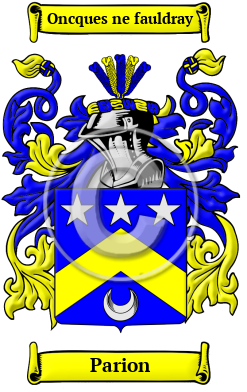
| ![Show Contents]() Parion History, Family Crest & Coats of Arms Parion History, Family Crest & Coats of Arms
Etymology of ParionWhat does the name Parion mean? The name Parion dates back to the days of Medieval France, in the region of Normandy. It is derived from their residence in Normandy. The name Parion could also be derived from the Old French word "poirier," meaning "pear tree," and was used to distinguish a person who lived near such a tree. In some cases the name may have also been used to indicate a person who sold pears or owned an orchard. 1 Early Origins of the Parion familyThe surname Parion was first found in Normandy (French: Normandie), the former Duchy of Normandy, where they held a family seat in the seigneurie of Amfreville. Vincent Poirier, born in 1628, son of François and Michelle (née Bonar), came to New France in the 17th century and is recorded as the first person in Canada with the name Poirier. He married Françoise Pinguet on 8th February 1655. He married again to Judith Renaudeau on 6th December 1662. Vincent died in Quebec on 28th April 1703. 2 Early History of the Parion familyThis web page shows only a small excerpt of our Parion research. Another 69 words (5 lines of text) covering the years 1097 and 1167 are included under the topic Early Parion History in all our PDF Extended History products and printed products wherever possible. Parion Spelling VariationsFrench surnames were subject to numerous spelling alterations depending on the region and time it was used. The early development of the French language relied heavily on borrowing elements and grammar from other languages. For example, Old French was infused with Germanic words and sounds when barbarian tribes invaded and settled in France after the fall of the Roman Empire. Middle French also borrowed heavily from the Italian language during the Renaissance. As a result of these linguistic and cultural influences, the name Parion is distinguished by a number of regional variations. The many spelling variations of the name include Poirer, Poirrer, Poirier, Poirrier, Poiré, Poirré, Poirière, Poirrière, Poirez, Poirrez, Poiriez and many more. Early Notables of the Parion familyMore information is included under the topic Early Parion Notables in all our PDF Extended History products and printed products wherever possible. Migration of the Parion familyIn the 1700s, land incentives were finally given out by France to 2,000 migrants. Early marriage was encouraged in New France, and youths of 18 took fourteen-year-old girls for their wives. The fur trade was developed and attracted migrants, both noble and commoner from France. 15,000 explorers left Montreal in the late 17th and 18th centuries, leaving French names scattered across the continent. The search for the Northwest passage continued. Migration from France to New France or Quebec, as it was now more popularly called, continued until 1759. By 1675, there were 7000 French in Quebec. By the same year the Acadian presence in Nova Scotia, New Brunswick and Prince Edward Island had reached 500. In the treaty of Utrecht, Acadia were ceded by France to Britain in 1713. In 1755, 10,000 French Acadians refused to take an oath of allegiance to England and were deported. They found refuge in Louisiana. Meanwhile, in Quebec, the French race flourished, founding in Lower Canada, one of the two great solitudes which became Canada. Many of this distinguished family name Parion were prominent in social, cultural, religious and political affairs in France and New France. Amongst the settlers in North America with this distinguished name Parion were Vincent, who arrived in Quebec from Ile-de-France in 1665; Jean, who arrived in Quebec from Guyenne in 1668; Jean, who arrived in Quebec from Béarn in 1669.
The motto was originally a war cry or slogan. Mottoes first began to be shown with arms in the 14th and 15th centuries, but were not in general use until the 17th century. Thus the oldest coats of arms generally do not include a motto. Mottoes seldom form part of the grant of arms: Under most heraldic authorities, a motto is an optional component of the coat of arms, and can be added to or changed at will; many families have chosen not to display a motto.
Motto: Oncques ne fauldray
Motto Translation: Never falter.
- Dauzat, Albert, Morlet, Marie-Thérèse, Dictionaire Étymologique des Noms et Prénoms de France. Paris: Librairie Larousse, 1987. Print.
- Olivier, Reginald L. Your Ancient Canadian Family Ties. Logan: The Everton Publishers, Inc., P.O. Box 368, 1972. Print
 |