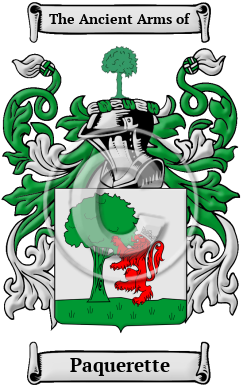
| ![Show Contents]() Paquerette History, Family Crest & Coats of Arms Paquerette History, Family Crest & Coats of Arms
- Origins Available:
France
Etymology of PaqueretteWhat does the name Paquerette mean? The Paquerette surname comes from the personal name Pasquet, which was a form of Pascal. The Old French word, "pacquet", meant "bundle of kindling", thus in some instances, the name may have originally been an occupational name for a gatherer or seller of firewood or kindling. Early Origins of the Paquerette familyThe surname Paquerette was first found in Limousin where they held a family seat in the seigneurie of Salaignac, and were members of the distinguished aristocracy of that region. The family also moved across the border into Belgium in the province of Namur, and there the family flourished and were elevated to the nobility in 1770 as Lords or Seigneures, continuing to 1819, and as Barons in 1844, where they held a family seat at d'Acos. They also had domains in the region of d'Angoulème in Belgium. Meanwhile in France they branched to Dauphiné, Brittany, and to Lorraine where they became Seigneurs in 1708. Isaac Paquet, son of Mathurin and Marie (née Fumillon), travelled from Poitou, France to Canada in the 17th century. He married Elisabeth Meunier on 30th June 1670 at Château-Richer, Quebec. Isaac passed away on 1702 and was buried at Saint-Laurent-de-l'ìle-d'Orléans, Quebec on 18th June 1702. 1 Early History of the Paquerette familyThis web page shows only a small excerpt of our Paquerette research. The years 1529, 1767 and 1862 are included under the topic Early Paquerette History in all our PDF Extended History products and printed products wherever possible. Paquerette Spelling VariationsChanges of spelling have occurred in most surnames. The earliest explanation is that during the early development of the French language, names were not yet fixed in spelling. Usually a person gave his version of his name, phonetically, to a scribe, a priest, or a recorder. This depended on accent, and local accents frequently changed the spelling of a name. Some variables were adopted by different branches of the family name. Hence, there are some spelling variations of the name Paquerette, including Pasquet, Paquet, Paquett, Paquette, Paquitt, Pacquet, Pacquett, Pacquette, Paquit, Paquitte, Paquotte, Paquott, Paquot, Pasquier, Pasquiet, Passaquet, Passquet and many more. Early Notables of the Paquerette familyÉtienne Pasquier (June 7, 1529 - September 1, 1615) was a French lawyer and man of letters. Later, the Baron and Duke Pasquier, (1767-1862) was a noted French politician. A Councillor in Parliament who was imprisoned during the Terror, he...
Another 40 words (3 lines of text) are included under the topic Early Paquerette Notables in all our PDF Extended History products and printed products wherever possible. Migration of the Paquerette familyMigration from France to New France or Quebec as it was now more popularly called, continued from France until it fell in 1759. By 1675, there were 7000 French in Quebec. By the same year the Acadian presence in Nova Scotia, New Brunswick and Prince Edward Island had reached 500. In the treaty of Utrecht, the Acadians were ceded by France to Britain in 1713. In 1755, 10,000 French Acadians refused to take an oath of allegiance to England and were deported. They found refuge in Louisiana. In 1793, the remaining French in these provinces came under British rule. Meanwhile, in Quebec, the French race flourished, founding in Lower Canada, one of the two great solitudes which became Canada. Many of this distinguished family name Paquerette were prominent in social, cultural, religious and political affairs in France and New France. Amongst the settlers in North America with this distinguished name Paquerette were Widow Paquot who settled in Philadelphia in 1796 with her daughter; Anton Paquet settled in Philadelphia in 1848; Isaac Paquet settled in Quebec in 1665 at Vallé.
- Olivier, Reginald L. Your Ancient Canadian Family Ties. Logan: The Everton Publishers, Inc., P.O. Box 368, 1972. Print
 |