| ![Show Contents]() Pagitt History, Family Crest & Coats of Arms Pagitt History, Family Crest & Coats of Arms
Etymology of PagittWhat does the name Pagitt mean? Pagitt is one of the many new names that came to England following the Norman Conquest of 1066. The Pagitt family lived in Oxfordshire. The name, however, is a reference to Pachet, Normandy, the family's place of residence prior to the Norman Conquest of England in 1066. Some of the family remained in Normandy as seen by this entry: "William Pachet, Normandy 1180." 1 Early Origins of the Pagitt familyThe surname Pagitt was first found in Oxfordshire and Derbyshire. Mickleover, Derbyshire was an early homestead of the family. "The manor was given, with Findern, Littleover, and Potlac, by William the Conqueror, to Burton Abbey; Henry VIII. granted these manors to Sir William Paget." 2 Presumably the same Sir William was granted estates in Aston-Upon-Trent. "The manor was granted after the Reformation to Sir William Paget." 2 Early History of the Pagitt familyThis web page shows only a small excerpt of our Pagitt research. Another 172 words (12 lines of text) covering the years 1180, 1506, 1540, 1547, 1551, 1563, 1572, 1575, 1590, 1609, 1612, 1615, 1617, 1629, 1632, 1637, 1639, 1645, 1647, 1664, 1678, 1679, 1689, 1692, 1701 and 1713 are included under the topic Early Pagitt History in all our PDF Extended History products and printed products wherever possible. Pagitt Spelling VariationsAnglo-Norman names are characterized by a multitude of spelling variations. When the Normans became the ruling people of England in the 11th century, they introduced a new language into a society where the main languages of Old and later Middle English had no definite spelling rules. These languages were more often spoken than written, so they blended freely with one another. Contributing to this mixing of tongues was the fact that medieval scribes spelled words according to sound, ensuring that a person's name would appear differently in nearly every document in which it was recorded. The name has been spelled Paget, Pagit, Pagitt, Pagett, Pagget, Paggett and others. Early Notables of the Pagitt family- Ephraim Pagit (Pagitt) (c.1575–1647), an English clergyman and heresiographer, best known for his Heresiography of 1645
Migration of the Pagitt family to IrelandSome of the Pagitt family moved to Ireland, but this topic is not covered in this excerpt.
Another 39 words (3 lines of text) about their life in Ireland is included in all our PDF Extended History products and printed products wherever possible.
| Pagitt migration to the United States | + |
For many English families, the political and religious disarray that plagued their homeland made the frontiers of the New World an attractive prospect. Thousands migrated, aboard cramped disease-ridden ships. They arrived sick, poor, and hungry, but were welcomed in many cases with far greater opportunity than at home in England. Many of these hardy settlers went on to make important contributions to the emerging nations in which they landed. Among early immigrants bearing the name Pagitt or a variant listed above were:
Pagitt Settlers in United States in the 17th Century- Anthony Pagitt, aged 35, who landed in Virginia in 1623 aboard the ship "Southampton" 3
| Historic Events for the Pagitt family | + |
USS Indianapolis - Eldon Ernest Pagitt, American crew member on board the ship "USS Indianapolis" when she was on a top secret trip for the first nuclear weapon, she was sunk by Japanese Navy on 30th July 1945, he was one of the many who were killed in the sinking due to exposure, dehydration, saltwater poisoning and shark attacks 4
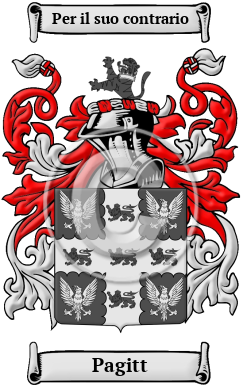
The motto was originally a war cry or slogan. Mottoes first began to be shown with arms in the 14th and 15th centuries, but were not in general use until the 17th century. Thus the oldest coats of arms generally do not include a motto. Mottoes seldom form part of the grant of arms: Under most heraldic authorities, a motto is an optional component of the coat of arms, and can be added to or changed at will; many families have chosen not to display a motto.
Motto: Per il suo contrario
Motto Translation: By its reverse.
- The Norman People and Their Existing Descendants in the British Dominions and the United States Of America. Baltimore: Genealogical Publishing, 1975. Print. (ISBN 0-8063-0636-X)
- Lewis, Samuel, A Topographical Dictionary of England. Institute of Historical Research, 1848, Print.
- Filby, P. William, Meyer, Mary K., Passenger and immigration lists index : a guide to published arrival records of about 500,000 passengers who came to the United States and Canada in the seventeenth, eighteenth, and nineteenth centuries. 1982-1985 Cumulated Supplements in Four Volumes Detroit, Mich. : Gale Research Co., 1985, Print (ISBN 0-8103-1795-8)
- Final Crew List, retrieved 2021, October 30th Retrieved from https://www.ussindianapolis.com/final-crew
 |