
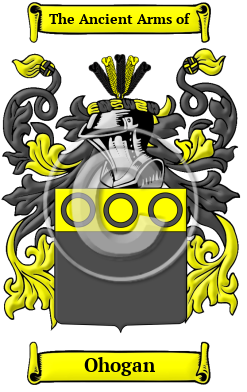
Show ContentsOhogan History, Family Crest & Coats of Arms

Etymology of Ohogan

What does the name Ohogan mean?

There are a multitude of ancient meanings and variations associated with the Irish surnames that are now common throughout the modern world. The original Gaelic form of the name Ohogan is Ó hÓgáin, meaning a descendant of Ógán’, a personal name derived from the Irish Gaelic word "og," which means "young."

Early Origins of the Ohogan family

The surname Ohogan was first found in County Tipperary (Irish: Thiobraid Árann), established in the 13th century in South-central Ireland, in the province of Munster where one of the first records of the name was Mathew O'Hogan a native of Ballyhogan and Dean of Killaloe who died in 1281. He held the position from 1267 until his death when he was interred in the Dominican convent at Limerick. Thus began the long line of O'Hogans who held lofty positions in the church. His successor was Maurice O'Hogan, who was consecrated in 1282 and governed his see for seventeen years until his death. Thomas O'Hogan, canon of Killaloe was consecrated bishop of the see in 1343 until his death in 1354.

Early History of the Ohogan family

This web page shows only a small excerpt of our Ohogan research. Another 67 words (5 lines of text) are included under the topic Early Ohogan History in all our PDF Extended History products and printed products wherever possible.

Ohogan Spelling Variations

Within archives, many different spelling variations exist for the surname Ohogan. Ancient scribes and church officials recorded names as they were pronounced, often resulting in the name of the single person being recorded under several different spellings. Different spellings that were found include Hogan, O'Hogan, Hogen, Hoggin and others.

Early Notables of the Ohogan family

More information is included under the topic Early Ohogan Notables in all our PDF Extended History products and printed products wherever possible.


Ohogan migration to New Zealand +

Emigration to New Zealand followed in the footsteps of the European explorers, such as Captain Cook (1769-70): first came sealers, whalers, missionaries, and traders. By 1838, the British New Zealand Company had begun buying land from the Maori tribes, and selling it to settlers, and, after the Treaty of Waitangi in 1840, many British families set out on the arduous six month journey from Britain to Aotearoa to start a new life. Early immigrants include:

Ohogan Settlers in New Zealand in the 19th Century
  • Edward O'Hogan, who arrived in Auckland, New Zealand aboard the ship "Sydenham" in 1870
  • Charles O'Hogan, who arrived in Auckland, New Zealand aboard the ship "Sydenham" in 1870


Houseofnames.com on Facebook
