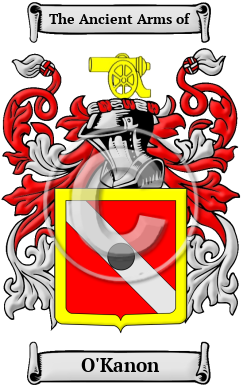
| ![Show Contents]() O'Kanon History, Family Crest & Coats of Arms O'Kanon History, Family Crest & Coats of Arms
- Origins Available:
Ireland
Etymology of O'KanonWhat does the name O'Kanon mean? While the Anglicized versions of Irish names are often familiar to people, their Irish Gaelic heritage is often unknown. The original Gaelic form of the name O'Kanon is Ó Canain, from the word "cano," which means "wolf cub." 1 Early Origins of the O'Kanon familyThe surname O'Kanon was first found in Tirconnell (Irish: Tír Chonaill) present day Donegal, located in Northwestn Ireland in the province of Ulster, where they held a family seat from very ancient times. Early History of the O'Kanon familyThis web page shows only a small excerpt of our O'Kanon research. Another 156 words (11 lines of text) covering the years 1500, 1659 and 1687 are included under the topic Early O'Kanon History in all our PDF Extended History products and printed products wherever possible. O'Kanon Spelling VariationsBecause early scribes and church officials often spelled names as they sounded, a person could have many various spellings of his name.Many different spelling variations of the surname O'Kanon were found in the archives researched. These included Cannon, O'Cannon, MacCannon, Cannan, Cannen, Cannin, MacCannan, McCannon, McCannan and many more. Early Notables of the O'Kanon familyMore information is included under the topic Early O'Kanon Notables in all our PDF Extended History products and printed products wherever possible. Migration of the O'Kanon familyIn the 18th and 19th centuries, thousands of Irish families fled an Ireland that was forcibly held through by England through its imperialistic policies. A large portion of these families crossed the Atlantic to the shores of North America. The fate of these families depended on when they immigrated and the political allegiances they showed after they arrived. Settlers that arrived before the American War of Independence may have moved north to Canada at the war's conclusion as United Empire Loyalists. Such Loyalists were granted land along the St. Lawrence River and the Niagara Peninsula. Those that fought for the revolution occasionally gained the land that the fleeing Loyalist vacated. After this period, free land and an agrarian lifestyle were not so easy to come by in the East. So when seemingly innumerable Irish immigrants arrived during the Great Potato Famine of the late 1840s, free land for all was out of the question. These settlers were instead put to work building railroads, coal mines, bridges, and canals. Whenever they came, Irish settlers made an inestimable contribution to the building of the New World. Early North American immigration records have revealed a number of people bearing the Irish name O'Kanon or a variant listed above, including: Edward and Ann Cannon who settled in Virginia in 1646; John Cannon settled in Barbados in 1660; another John settled in Jamaica in 1716; Alexander, Andrew, Anthony, Barney, Bernard, Bridget, Charles, Cornelius, Daniel Dennis, Edward, Ennis, George, Hugh, James, John, Mannis, Michael, Neal, Owen, Patrick, Philip, Thomas and William Cannon all settled in Philadelphia, Pennsylvania between 1772 and 1866.
- MacLysaght, Edward, The Surnames of Ireland. Ireland: Irish Academic Press, sixth edition, 1985. Print. (ISBN 0-7165-2366-3)
 |