| ![Show Contents]() O'Floould History, Family Crest & Coats of Arms O'Floould History, Family Crest & Coats of Arms
- Origins Available:
Ireland
Etymology of O'FloouldWhat does the name O'Floould mean? The Irish surname O'Floould begins was originally the Gaelic MacTuile, Ó Maoltuile, or Mac Maoltuile. "tuile" means "flood," and the names Tully and Flood were at one time interchangeable in Ireland. 1 However, some of the Gaelic names that have become "flood" may have been mistranslations, and that contained the Gaelic "toile," meaning "toil," or "will." In Ulster, Floyd has sometimes been used as a spelling variant of Flood; however, Floyd is normally a cognate of the Welsh name Lloyd, derived from the word 'llwyd,' which means ‘grey.’ Early Origins of the O'Floould familyThe surname O'Floould was first found in Connacht, where they could be found since ancient times, and were hereditary physicians to the O'Connors of Galway. Early History of the O'Floould familyThis web page shows only a small excerpt of our O'Floould research. Another 125 words (9 lines of text) covering the years 1563, 1572, 1574, 1589, 1592, 1593, 1603, 1620, 1637, 1641, 1648, 1649, 1660, 1675 and 1676 are included under the topic Early O'Floould History in all our PDF Extended History products and printed products wherever possible. O'Floould Spelling VariationsWithin the archives researched, many different spelling variations of the surname O'Floould were found. These included One reason for the many variations is that scribes and church officials often spelled an individual's name as it sounded. This imprecise method often led to many versions. Flood, Floyd, Floode, Floyde, Tully, MacTully,Talley, Tally and many more. Early Notables of the O'Floould familyThomas Tully (1620-1676), an English clergyman of Calvinist views. He was born in St. Mary's parish, Carlisle and was son of George Tully. "After the Restoration he was created D.D. on 9 Nov. 1660, and nominated one of the Royal Chaplains in Ordinary, and in April 1675 was appointed Dean of Ripon. " 2
Edward Floyd, Floud or LLoyd (d. 1648?), was a Catholic barrister who became steward in Shropshire to Lord-Chancellor Ellesmere and the Earl of Suffolk. 2
Henry Floyd (1563-1641), was an English Jesuit, elder brother of Father John Floyd, born in Cambridgeshire in 1563. Father John Floyd (1572-1649), was an...
Another 120 words (9 lines of text) are included under the topic Early O'Floould Notables in all our PDF Extended History products and printed products wherever possible. Migration of the O'Floould familyDuring the 19th century thousands of impoverished Irish families made the long journey to British North America and the United States. These people were leaving a land that had become beset with poverty, lack of opportunity, and hunger. In North America, they hoped to find land, work, and political and religious freedoms. Although the majority of the immigrants that survived the long sea passage did make these discoveries, it was not without much perseverance and hard work: by the mid-19th century land suitable for agriculture was short supply, especially in British North America, in the east; the work available was generally low paying and physically taxing construction or factory work; and the English stereotypes concerning the Irish, although less frequent and vehement, were, nevertheless, present in the land of freedom, liberty, and equality for all men. The largest influx of Irish settlers occurred with Great Potato Famine during the late 1840s. Research into passenger and immigration lists has brought forth evidence of the early members of the O'Floould family in North America: Edmund Flood who landed in Massachusetts in 1620; David Flood settled in Virginia in 1637; followed by Abraham Flood 1650; John in 1652; Arthur Floyd settled in Virginia in 1647.
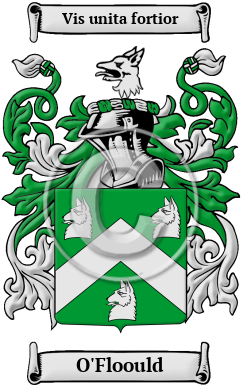
The motto was originally a war cry or slogan. Mottoes first began to be shown with arms in the 14th and 15th centuries, but were not in general use until the 17th century. Thus the oldest coats of arms generally do not include a motto. Mottoes seldom form part of the grant of arms: Under most heraldic authorities, a motto is an optional component of the coat of arms, and can be added to or changed at will; many families have chosen not to display a motto.
Motto: Vis unita fortior
Motto Translation: Strength united is the more powerful.
- MacLysaght, Edward, The Surnames of Ireland. Ireland: Irish Academic Press, sixth edition, 1985. Print. (ISBN 0-7165-2366-3)
- Smith, George (ed), Dictionary of National Biography. London: Smith, Elder & Co., 1885-1900. Print
 |