
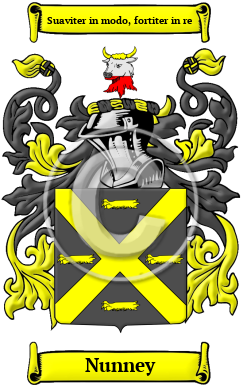
Show ContentsNunney History, Family Crest & Coats of Arms

Etymology of Nunney

What does the name Nunney mean?

The Nunney surname derives from the Old English word "nunne," in turn from the Latin "nonna," both of which mean a "Nun." As a name, it was likely originally a nickname for a pious person, or an occupational name for someone who worked at a convent.

Early Origins of the Nunney family

The surname Nunney was first found in Norfolk where they held a family seat from early times and their first records appeared on the early census rolls taken by the early Kings of Britain to determine the rate of taxation of their subjects.

Early History of the Nunney family

This web page shows only a small excerpt of our Nunney research. Another 94 words (7 lines of text) covering the year 1514 is included under the topic Early Nunney History in all our PDF Extended History products and printed products wherever possible.

Nunney Spelling Variations

Spelling variations of this family name include: Noon, Noone, Nunn, Nones, None, Nun and others.

Early Notables of the Nunney family

More information is included under the topic Early Nunney Notables in all our PDF Extended History products and printed products wherever possible.

Migration of the Nunney family to Ireland

Some of the Nunney family moved to Ireland, but this topic is not covered in this excerpt. More information about their life in Ireland is included in all our PDF Extended History products and printed products wherever possible.

Migration of the Nunney family

Some of the first settlers of this family name or some of its variants were: Thomas Nunn, who settled in Virginia in 1635; John Nunn settled in Virginia in 1695; Charles, George, James, John, and Patrick Noon settled in Philadelphia between 1840 and 1870.


Contemporary Notables of the name Nunney (post 1700)+

  • Private Claude Joseph Patrick Nunney (1892-1918), Canadian recipient of the Victoria Cross during the First World War 1


The Nunney Motto+

The motto was originally a war cry or slogan. Mottoes first began to be shown with arms in the 14th and 15th centuries, but were not in general use until the 17th century. Thus the oldest coats of arms generally do not include a motto. Mottoes seldom form part of the grant of arms: Under most heraldic authorities, a motto is an optional component of the coat of arms, and can be added to or changed at will; many families have chosen not to display a motto.

Motto: Suaviter in modo, fortiter in re
Motto Translation: Gentle in manner, firm in act.


  1. The Canadian Virtual War Memorial (CVWM). (Retrieved 2010, September 27) Claude Nunney. Retrieved from http://www.vac-acc.gc.ca/remembers/sub.cfm?source=collections/virtualmem/Detail&casualty=996076


Houseofnames.com on Facebook