| ![Show Contents]() Noyé History, Family Crest & Coats of Arms Noyé History, Family Crest & Coats of Arms
- Origins Available:
England
France
Etymology of NoyéWhat does the name Noyé mean? The ancestors of the Noyé family migrated to England following the Norman Conquest of 1066. The surname Noyé is based on the Old English given name Noye. Early Origins of the Noyé familyThe surname Noyé was first found in Cornwall. "Pen-tre, Pendre, or Pendray, in this parish, gave its name to a family thence called Pendray, so early as the reign of Henry VI. About this time, on the failure of male heirs, two heiresses carried the family estates by marriage to Bonython of Carclew, and Noye. Pendray fell to the share of Noye, on which estates the family resided for several descents; William Noye, the celebrated attorney general of Charles I. was born here. Burmuhall in this parish, was also another seat belonging to the Noyes, in which it has been said that William Noye was born." 1 At one time, some of the family held the manor of Amalibria in the parish of Towednack, Cornwall. This was held by Humphrey Noy, Esq., but he conveyed it to his son-in-law Davies. No year is given for this entry. 1 Early History of the Noyé familyThis web page shows only a small excerpt of our Noyé research. Another 90 words (6 lines of text) covering the years 1524, 1568, 1614, 1622, 1647 and 1717 are included under the topic Early Noyé History in all our PDF Extended History products and printed products wherever possible. Noyé Spelling VariationsBefore English spelling was standardized a few hundred years ago, spelling variations of names were a common occurrence. Elements of Latin, Norman French and other languages became incorporated into English throughout the Middle Ages, and name spellings changed even among the literate. The variations of the surname Noyé include Noyes, Noye, Nye, Nie, Noyers, Noyce, Noise and others. Early Notables of the Noyé family- Robert Noyes (1524-1614)
- Rev. William Noyes (1568-1622), an English clergyman, Rector of Cholderton, Wiltshire. Peter Noyes was an English politician, Member of Parliament for Andover in 1614. Reverend Nicholas Noyes Jr. (164...
| Noyé migration to the United States | + |
In England at this time, the uncertainty of the political and religious environment of the time caused many families to board ships for distant British colonies in the hopes of finding land and opportunity, and escaping persecution. The voyages were expensive, crowded, and difficult, though, and many arrived in North America sick, starved, and destitute. Those who did make it, however, were greeted with greater opportunities and freedoms that they could have experienced at home. Many of those families went on to make important contributions to the young nations in which they settled. Early immigration records have shown some of the first Noyés to arrive on North American shores:
Noyé Settlers in United States in the 17th Century- Mr. Phillip da la Noye, who arrived in Plymouth, Massachusetts in 1621 aboard the ship "Fortune" 2
| Noyé migration to Australia | + |
Noyé Settlers in Australia in the 19th Century- Miss Annie Noye, (b. 1884), aged 1, Cornish settler travelling aboard the ship "Quetta" arriving in Queensland, Australia on 19th November 1885 3
- Mrs. Emma Noye, (b. 1861), aged 24, Cornish settler travelling aboard the ship "Quetta" arriving in Queensland, Australia on 19th November 1885 3
- Mr. William Noye, (b. 1854), aged 31, Cornish settler travelling aboard the ship "Quetta" arriving in Queensland, Australia on 19th November 1885 3
| Noyé migration to New Zealand | + |
Emigration to New Zealand followed in the footsteps of the European explorers, such as Captain Cook (1769-70): first came sealers, whalers, missionaries, and traders. By 1838, the British New Zealand Company had begun buying land from the Maori tribes, and selling it to settlers, and, after the Treaty of Waitangi in 1840, many British families set out on the arduous six month journey from Britain to Aotearoa to start a new life. Early immigrants include: Noyé Settlers in New Zealand in the 19th Century- Mr. Joseph W. Noye, (b. 1856), aged 19, Cornish labourer departing on 13th December 1875 aboard the ship "Brodick Castle" arriving in Auckland, New Zealand on 24th March 1876 4
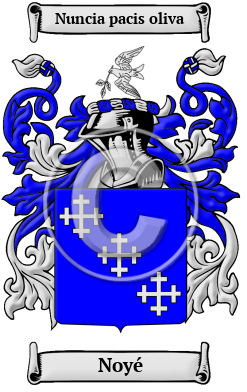
The motto was originally a war cry or slogan. Mottoes first began to be shown with arms in the 14th and 15th centuries, but were not in general use until the 17th century. Thus the oldest coats of arms generally do not include a motto. Mottoes seldom form part of the grant of arms: Under most heraldic authorities, a motto is an optional component of the coat of arms, and can be added to or changed at will; many families have chosen not to display a motto.
Motto: Nuncia pacis oliva
Motto Translation: A message of peace.
- Hutchins, Fortescue, The History of Cornwall, from the Earliest Records and Traditions to the Present Time. London: William Penaluna, 1824. Print
- Pilgrim Ship's of 1600's Retrieved January 6th 2023, retrieved from https://www.packrat-pro.com/ships/shiplist.htm
- Cornwall Online Parish Clerks. (Retreived 3rd May 2018). Retrieved from http://www.opc-cornwall.org/Resc/pdfs/emigration_australia_queensland.pdf
- Cornwall Online Parish Clerks. (Retrieved 2018, April 30). Emigrants to Auckland 1872-80 [PDF]. Retrieved from http://www.opc-cornwall.org/Resc/pdfs/new_zealand_assisted.pdf
 |