| ![Show Contents]() Nolly History, Family Crest & Coats of Arms Nolly History, Family Crest & Coats of Arms
Etymology of NollyWhat does the name Nolly mean? The Nolly family history stretches back to the clans of the Dalriadan kingdom on the sea-swept Hebrides islands and mountainous western coast of Scotland. The name Nolly is derived from the personal name Neil. The Gaelic form Mac Neill translates as son of Neil. Early Origins of the Nolly familyThe surname Nolly was first found in on the islands of Barra, Gigha, Colonsay, and Oronsay. According to traditional records in 1049, Niall, a direct descendent of King Niall of the Nine Hostages, landed in Barra and founded the Clan MacNeill of Barra. However, another kinsman, some believe to be the younger brother of Niall named Anrothan, married a Princess of the Dalriadans, an ancient race from which sprang most of the early Scottish Kings. Legend has it that Anrothan started the MacNeill house of Colonsay through his son Torquil of Taynish. This latter branch acquired the lands of Gigha, Colonsay and Oronsay, beyond the Firth of Lorne. For the next two centuries it appears as though these two great houses were developing independently of one another. Early History of the Nolly familyThis web page shows only a small excerpt of our Nolly research. Another 361 words (26 lines of text) covering the years 1370, 1380, 1526, 1562, 1590, 1612, 1613, 1631, 1640, 1686, 1730 and 1890 are included under the topic Early Nolly History in all our PDF Extended History products and printed products wherever possible. Nolly Spelling VariationsSpelling in the medieval era was a highly imprecise process. Translation, particularly from Gaelic to English, was little better. For these reasons, early Scottish names are rife with spelling variations. In various documents Nolly has been spelled MacNeil, MacNeill, MacNeal, MacNeilage, MacNeale, MacNeall, MacNeille, MacNeel, MacNiel, MacGreal, Mcneil, Mcneill, McNeal, Mcneal, Mcneall and many more. Early Notables of the Nolly familyNigel M'Nele, Laird of Blarekanne c. 1370-1380; Alexander Makneyll, a notary public in Edinburgh in 1526; Richard Neile (1562-1640) was an English churchman, Archbishop of York (1631-1640), he was involved in the...
Another 32 words (2 lines of text) are included under the topic Early Nolly Notables in all our PDF Extended History products and printed products wherever possible. Migration of the Nolly family to IrelandSome of the Nolly family moved to Ireland, but this topic is not covered in this excerpt.
Another 85 words (6 lines of text) about their life in Ireland is included in all our PDF Extended History products and printed products wherever possible.
| Nolly migration to the United States | + |
Settlers from Scotland put down roots in communities all along the east coast of North America. Some moved north from the American colonies to Canada as United Empire Loyalists during the American War of Independence. As Clan societies and highland games started in North America in the 20th century many Scots rediscovered parts of their heritage. Early North American records indicate many people bearing the name Nolly were among those contributors:
Nolly Settlers in United States in the 19th Century- John Nolly, who landed in New York in 1836 1
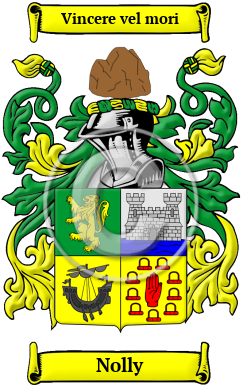
The motto was originally a war cry or slogan. Mottoes first began to be shown with arms in the 14th and 15th centuries, but were not in general use until the 17th century. Thus the oldest coats of arms generally do not include a motto. Mottoes seldom form part of the grant of arms: Under most heraldic authorities, a motto is an optional component of the coat of arms, and can be added to or changed at will; many families have chosen not to display a motto.
Motto: Vincere vel mori
Motto Translation: To conquer or die.
- Filby, P. William, Meyer, Mary K., Passenger and immigration lists index : a guide to published arrival records of about 500,000 passengers who came to the United States and Canada in the seventeenth, eighteenth, and nineteenth centuries. 1982-1985 Cumulated Supplements in Four Volumes Detroit, Mich. : Gale Research Co., 1985, Print (ISBN 0-8103-1795-8)
 |