| ![Show Contents]() Neysmith History, Family Crest & Coats of Arms Neysmith History, Family Crest & Coats of Arms
- Origins Available:
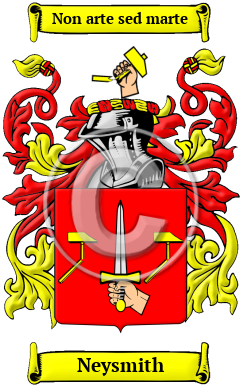
Scotland
England
Etymology of NeysmithWhat does the name Neysmith mean? The surname Neysmith is thought to be an occupational name for a maker of knives or nails, deriving from the Old English "cnif," meaning "knife," or "noegel," meaning "nail" combined with "smith." 1 One source notes, the name is derived from "Nail-smith; but they bear two broken hammers in their Arms, as if the name were No smith !" 2 Neysmith Coat of Arms CreationIn his autobiography, James Nasmyth, the engineer, tells that in the reign of James III. of Scotland the Earl of Douglas was a rebel, and crossed from England determined to resist the Royal power. He was met by the Earl of Angus, the Maxwells, the Johnstones, and the Scotts. In one of the encounters with them Douglas was victorious, and an ancestor of the Nasmyths, who fought for the King, took refuge in a village smithy. The smith offered him protection, dis-guised him as a hammerman with a leathern apron, and asked him to lend a hand at his work. While thus at work, several of the Douglas followers entered the smithy. The disguised hammerman saw that they suspected him, and in his agitation struck a false blow with his sledgehammer and broke the shaft in two. On seeing this, one of the pursuers rushed at him, calling out, " Ye're nae smyth." The hammerman turned upon his assailant, and, wrenching a dagger from him, speedily overpowered him. The smith also helped to drive out the Douglas men. A party of the King's soldiers appeared, Nasymth rallied them, and turned defeat into victory. For this he got a grant of lands, and as armorial bearings he took a right hand with a dagger between two broken hammer shafts. The motto was, " Non arte sed marte " (Not by art but by war): Since then the motto has been reversed, and stands " Non marte sed arte," and instead of the broken hammer shafts there is the device of the famous Nasmyth steam hammer. 3 Early Origins of the Neysmith familyThe surname Neysmith was first found in Renfrewshire (Gaelic: Siorrachd Rinn Friù), a historic county of Scotland, today encompassing the Council Areas of Renfrew, East Renfrewshire, and Iverclyde, in the Strathclyde region of southwestern Scotland, where they held a family seat from early times and their first records appeared on the early census rolls taken by the early Kings of Scotland to determine the rate of taxation of their subjects. 4 "Adam Nasmith, owner of lands at Brechin, died before 1420. The Nasmyths were an old family of burgesses at Hamilton. James Nasmytht, witness in Glasgow, 1543. George Nasmyth was one of those hanged for holding Paisley against the king and his regent, 1565, and John Nesmyt is mentioned by Moysie as one of those concerned in a conspiracy in Holyrood, 27 December 1591. There was a resignation of property in favor of Robert Nasmyth in Glasgow, 1552." 4 Further to the south in England, Hugh Nasmith was listed in Yorkshire in 1277. 5 And it is here in England that we find definitive proof of the former spellings of the family. Roger Knifsmith was listed in London 1246-1289; Adam Knyfsmith in the Assize Rolls for Lancashire in 1285; Saman le Knyfsmyth in Devon in 1310; William Knysmyt in the Assize Rolls for Staffordshire in 1326; and Robert Knysmithe was listed in 1594. 5 Early History of the Neysmith familyThis web page shows only a small excerpt of our Neysmith research. Another 129 words (9 lines of text) covering the years 1400, 1552, 1579, 1619, 1626, 1630, 1684, 1720, 1730, 1740, 1741, 1758, 1760, 1764, 1765, 1767, 1771, 1778, 1779, 1797, 1808, 1820, 1840 and 1890 are included under the topic Early Neysmith History in all our PDF Extended History products and printed products wherever possible. Neysmith Spelling VariationsSurnames that evolved in Scotland in the Middle Ages often appear under many spelling variations. These are due to the practice of spelling according to sound in the era before dictionaries had standardized the English language. Neysmith has appeared as Naismith, Naysmith, Naesmyth, Nesmith, Nasmyth and others. Early Notables of the Neysmith familyJohn Nasmith or Naysmith (d. 1619?), Scottish "surgeon to James VI of Scotland and I of England, was second son of Michael Naesmith of Posso, Peeblesshire, and Elizabeth Baird. The family trace their descent to a stalwart knight, who while in attendance on Alexander III was unable to repair his armour, but so atoned for his lack of skill as a smith by his bravery in the fight that after its conclusion he was knighted by the king with the remark that, although ‘he was nae smith, he was a brave gentleman.’ Sir Michael, who was chamberlain to the Archbishop of...
Another 212 words (15 lines of text) are included under the topic Early Neysmith Notables in all our PDF Extended History products and printed products wherever possible. Migration of the Neysmith familyThe North American colonies beckoned, with their ample land and opportunity as their freedom from the persecution suffered by so many Clan families back home. Many Scots even fought against England in the American War of Independence to gain this freedom. Recently, Clan societies have allowed the ancestors of these brave Scottish settlers to rediscover their familial roots. Among them: James Nesmith, who settled in New Hampshire in 1718; as well as John Nesmith, who settled in Maryland in 1747.
| Contemporary Notables of the name Neysmith (post 1700) | + |
- John Neysmith, Canadian elected volunteer member of the World Scout Committee
The motto was originally a war cry or slogan. Mottoes first began to be shown with arms in the 14th and 15th centuries, but were not in general use until the 17th century. Thus the oldest coats of arms generally do not include a motto. Mottoes seldom form part of the grant of arms: Under most heraldic authorities, a motto is an optional component of the coat of arms, and can be added to or changed at will; many families have chosen not to display a motto.
Motto: Non arte sed marte
Motto Translation: Not by science but by war.
- Bardsley, C.W, A Dictionary of English and Welsh Surnames: With Special American Instances. Wiltshire: Heraldry Today, 1901. Print. (ISBN 0-900455-44-6)
- Dixon, Bernard Homer, Surnames. London: John Wilson and son, 1857. Print
- Polson, Alexander, The Romance of Scottish Crests and Mottoes. Inverness: Walter Alexander, Inglis Street 1929. Print
- Black, George F., The Surnames of Scotland Their Origin, Meaning and History. New York: New York Public Library, 1946. Print. (ISBN 0-87104-172-3)
- Reaney, P.H and R.M. Wilson, A Dictionary of English Surnames. London: Routledge, 1991. Print. (ISBN 0-415-05737-X)
 |