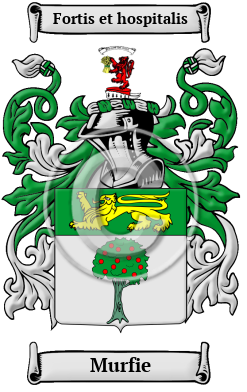
| ![Show Contents]() Murfie History, Family Crest & Coats of Arms Murfie History, Family Crest & Coats of Arms
Etymology of MurfieWhat does the name Murfie mean? Many of the oldest Irish surnames were originally in the Gaelic language native to Ireland. The original Gaelic form of the name Murfie is Ó Murchadha or Mac Murchadha, which are both derived from the word "murchadh," meaning "sea warrior." Early Origins of the Murfie familyThe surname Murfie was first found in County Wexford (Irish: Loch Garman), founded by Vikings as Waesfjord, and located in Southeastern Ireland, in the province of Leinster, where they held a family seat from very early times. Early History of the Murfie familyThis web page shows only a small excerpt of our Murfie research. Another 96 words (7 lines of text) covering the years 1127, 1172, 1650, 1716 and 1798 are included under the topic Early Murfie History in all our PDF Extended History products and printed products wherever possible. Murfie Spelling VariationsPronunciation, rather than spelling, guided scribes and church officials when recording names during the Middle Ages. This practice often resulted in one person's name being recorded under several different spellings. Numerous spelling variations of the surname Murfie are preserved in these old documents. The various spellings of the name that were found include Murphy, Morchoe, O'Murphy, Murfie, Murfree, Morfie, Morfey and many more. Early Notables of the Murfie familyAnother 32 words (2 lines of text) are included under the topic Early Murfie Notables in all our PDF Extended History products and printed products wherever possible.
| Murfie migration to the United States | + |
During the 19th century thousands of impoverished Irish families made the long journey to British North America and the United States. These people were leaving a land that had become beset with poverty, lack of opportunity, and hunger. In North America, they hoped to find land, work, and political and religious freedoms. Although the majority of the immigrants that survived the long sea passage did make these discoveries, it was not without much perseverance and hard work: by the mid-19th century land suitable for agriculture was short supply, especially in British North America, in the east; the work available was generally low paying and physically taxing construction or factory work; and the English stereotypes concerning the Irish, although less frequent and vehement, were, nevertheless, present in the land of freedom, liberty, and equality for all men. The largest influx of Irish settlers occurred with Great Potato Famine during the late 1840s. Research into passenger and immigration lists has brought forth evidence of the early members of the Murfie family in North America:
Murfie Settlers in United States in the 17th Century- Tho Murfie, aged 20, who arrived in Virginia in 1634 aboard the ship "Bonaventure" coming via St. Domingo 1
Murfie Settlers in United States in the 18th Century- Sarah Murfie, who landed in Virginia in 1716 1
The motto was originally a war cry or slogan. Mottoes first began to be shown with arms in the 14th and 15th centuries, but were not in general use until the 17th century. Thus the oldest coats of arms generally do not include a motto. Mottoes seldom form part of the grant of arms: Under most heraldic authorities, a motto is an optional component of the coat of arms, and can be added to or changed at will; many families have chosen not to display a motto.
Motto: Fortis et hospitalis
Motto Translation: Brave and hospitable.
- Filby, P. William, Meyer, Mary K., Passenger and immigration lists index : a guide to published arrival records of about 500,000 passengers who came to the United States and Canada in the seventeenth, eighteenth, and nineteenth centuries. 1982-1985 Cumulated Supplements in Four Volumes Detroit, Mich. : Gale Research Co., 1985, Print (ISBN 0-8103-1795-8)
 |