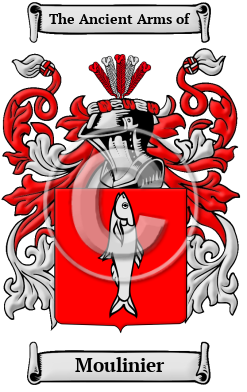
| ![Show Contents]() Moulinier History, Family Crest & Coats of Arms Moulinier History, Family Crest & Coats of Arms
- Origins Available:
France
Etymology of MoulinierWhat does the name Moulinier mean? Noble surnames, such as Moulinier, evoke images of the ancient homeland of the French people. The Moulinier surname may be a local surname, that is, a name derived from the name of a place where they once lived, or held land. The Moulinier family name is thought to have derived from Meunet, a town in the department of Indre, in the district of Issoudun. It has also been suggested that Moulinier may have been an occupational name for a miller, deriving from the word "meunier" or "mounier," in Old French. Early Origins of the Moulinier familyThe surname Moulinier was first found in Berry, a former province until 1790 when it became a region in central France where this ancient family held a family seat since early times. The members of the family also branched into other regions of France, such as in Normandy, where they settled in Mesnières, a town in the department of Seine-Inférieure, in the district of Neufchâtel. Many members of this prominent family made important contributions to the society. Philipe Meusnier was mentioned in historic documents of the Huguenot descendants. Claude-Marie Meunier was a colonel, who received his title to nobility in 1808, and Joseph Meunier, a general, entered into the nobility in 1809. Jean-Nicolas Démeunier (1751-1814) was a French politician. He was a deputy for the Estates General (1789), emigrated to the United States in 1792, and returned to France in 1797, where he became a tribune (1800), and then a senator (1802). This illustrious man was also the author of "Essai sur les États-Unis" (1786) and "L'Amérique indépendente" (1790). Mathurin Meunier, born in 1619, son of René and Marie (née Leroux), travelled from France to Canada in the 17th century. After arriving in Quebec he married Françoise Fafard, born in 1624, daughter of Jean and Elizabeth (née Tibou), at Montreal on 3rd November 1647. They remained there together until he passed away on 13th January 1702. 1 Early History of the Moulinier familyThis web page shows only a small excerpt of our Moulinier research. Another 20 words (1 lines of text) covering the years 1831 and 1905 are included under the topic Early Moulinier History in all our PDF Extended History products and printed products wherever possible. Moulinier Spelling VariationsSpelling variations of this family name include: Meunier, Lemeunier, Lesmeunier, Lémeunier, Meunié, Lemeunié, Munier, Lemunier, Meusnier, Lemeusnier, Demeunier, Desmeunier and many more. Early Notables of the Moulinier familyMore information is included under the topic Early Moulinier Notables in all our PDF Extended History products and printed products wherever possible. Moulinier RankingIn France, the name Moulinier is the 2,705th most popular surname with an estimated 2,000 - 2,500 people with that name. 2
| Moulinier migration to Canada | + |
Moulinier Settlers in Canada in the 17th Century- Nicolas Moulinier, aged 30, who landed in Canada in 1642
- Mr. Nicolas Moulinier, French settler travelling to Canada for work arriving on 5th April 1642 3
- Olivier, Reginald L. Your Ancient Canadian Family Ties. Logan: The Everton Publishers, Inc., P.O. Box 368, 1972. Print
- http://www.journaldesfemmes.com/nom-de-famille/nom/
- Debien, Gabriel. Liste Des Engagés Pour Le Canada Au XVIIe Siècle. Vol. 6, Laval University, 1952. (Retreived 24th May 2018). Retrieved from https://lebloguedeguyperron.wordpress.com/2016/06/30/130-liste-des-contrats-dengagement-pour-la-nouvelle-france-releves-a-la-rochelle-entre-1634-et-1679/
 |