| ![Show Contents]() Morrion History, Family Crest & Coats of Arms Morrion History, Family Crest & Coats of Arms
- Origins Available:
Scotland
Etymology of MorrionWhat does the name Morrion mean? The Scottish and Irish name Morrion is derived from the "Old Gaelic mugh-ron 'seal's slave'" The progenitor of the name is thought to have been "Mugron, comharb of Columcille in Ireland and Scotland, who died in 979. 1 Early Origins of the Morrion familyThe surname Morrion was first found in Galloway (Gaelic: Gall-ghaidhealaibh), an area of southwestern Scotland where some of the first records of the family include: John McMoryne, who witnessed a charter by Robert de Graham of lands in Kyle to Melrose Abbey, c. 1344; and Alan McMoryn, who witnessed the resignation by Sir David de Wemyss of certain lands in 1373. 1 Early History of the Morrion familyThis web page shows only a small excerpt of our Morrion research. Another 346 words (25 lines of text) covering the years 1376, 1381, 1394, 1395, 1408, 1466, 1495, 1529, 1565, 1575, 1576, 1592, 1595, 1627, 1636, 1667, 1684, 1696, 1758, 1780 and 1794 are included under the topic Early Morrion History in all our PDF Extended History products and printed products wherever possible. Morrion Spelling VariationsSpelling variations of this family name include: MacMorran, MacMoran, MacMurrin, MacMorrion, MacMorane and many more. Early Notables of the Morrion familyJohn MacMorran (d. 1595), Scottish merchant and Baillie of Edinburgh who was killed by rioting school children who were disputing the length of their holidays.
John MacMorran was a merchant involved in shipping, with shares in nine ships worth over...
Another 39 words (3 lines of text) are included under the topic Early Morrion Notables in all our PDF Extended History products and printed products wherever possible. Migration of the Morrion familySome of the first settlers of this family name or some of its variants were: Edward McMorran settled in New York in 1774; Jane McMoran settled in South Carolina with her husband and children in 1823.
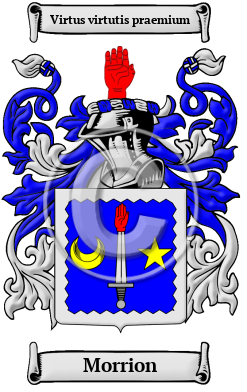
The motto was originally a war cry or slogan. Mottoes first began to be shown with arms in the 14th and 15th centuries, but were not in general use until the 17th century. Thus the oldest coats of arms generally do not include a motto. Mottoes seldom form part of the grant of arms: Under most heraldic authorities, a motto is an optional component of the coat of arms, and can be added to or changed at will; many families have chosen not to display a motto.
Motto: Virtus virtutis praemium
Motto Translation: Virtue is its own reward.
- Black, George F., The Surnames of Scotland Their Origin, Meaning and History. New York: New York Public Library, 1946. Print. (ISBN 0-87104-172-3)
 |