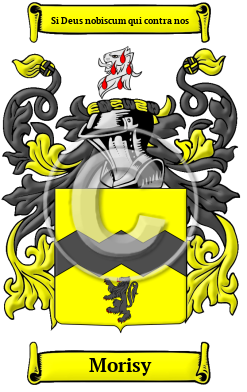
The Irish name Morisy has a long Gaelic heritage to its credit. The original Gaelic form of the name Morisy is Ó Muirgheasa, which is derived from the words muir, meaning sea, and geas, meaning action.
Loading...
Early Origins of the Morisy family
The surname Morisy was first found in County Sligo (Irish: Sligeach), in the province of Connacht in Northwestern Ireland.
Early History of the Morisy family
This web page shows only a small excerpt of our Morisy research. Another 54 words (4 lines of text) are included under the topic Early Morisy History in all our PDF Extended History products and printed products wherever possible.
Morisy Spelling Variations
Before widespread literacy came to Ireland, a name was often recorded under several different variations during the life of its bearer. Accordingly, numerous spelling variations were revealed in the search for the origin of the name Morisy family name. Variations found include Morrissey, O'Morrissey and others.
Early Notables of the Morisy family
More information is included under the topic Early Morisy Notables in all our PDF Extended History products and printed products wherever possible.
Loading...
Loading...
Loading...
Loading...
Migration of the Morisy family
Thousands of Irish families left for North American shores in the 19th century. These people were searching for a life unencumbered with poverty, hunger, and racial discrimination. Many arrived to eventually find such conditions, but many others simply did not arrive: victims of the diseased, overcrowded ships in which they traveled to the New World. Those who lived to see North American shores were instrumental in the development of the growing nations of Canada and the United States. A thorough examination of passenger and immigration lists has disclosed evidence of many early immigrants of the name Morisy: John Morrisey settled in Philadelphia in 1851; along with Patrick and Walter; Richard and William Morrissey settled in Boston in 1823; John Morrissey and Hannah with their six children settled in Quebec in 1848.
The motto was originally a war cry or slogan. Mottoes first began to be shown with arms in the 14th and 15th centuries, but were not in general use until the 17th century. Thus the oldest coats of arms generally do not include a motto. Mottoes seldom form part of the grant of arms: Under most heraldic authorities, a motto is an optional component of the coat of arms, and can be added to or changed at will; many families have chosen not to display a motto.
Motto: Si Deus nobiscum qui contra nos Motto Translation: If God be with us, who can be against us.
Remove Item
WARNING!
Removing this item from your shopping cart will remove your associated sale items.
Are you sure you want to delete this item from your shopping cart?