| ![Show Contents]() Millikan History, Family Crest & Coats of Arms Millikan History, Family Crest & Coats of Arms
Etymology of MillikanWhat does the name Millikan mean? The Millikan surname is an Anglicized form of the Gaelic Patronymic Ó Maolagáin, or "descendant of Maolagán," which is composed of the element "maol," meaning "bald’." Early Origins of the Millikan familyThe surname Millikan was first found in County Donegal (Irish: Dún na nGall), northwest Ireland in the province of Ulster, sometimes referred to as County Tyrconnel, where they held a family seat from very ancient times. Early History of the Millikan familyThis web page shows only a small excerpt of our Millikan research. Another 71 words (5 lines of text) covering the year 1431 is included under the topic Early Millikan History in all our PDF Extended History products and printed products wherever possible. Millikan Spelling VariationsSpelling variations of this family name include: Mulligan, O'Mulligan, Mullican, Mullighan, Mulliken and many more. Early Notables of the Millikan familyMore information is included under the topic Early Millikan Notables in all our PDF Extended History products and printed products wherever possible. Millikan Rankingthe United States, the name Millikan is the 16,815th most popular surname with an estimated 2,487 people with that name. 1 Migration of the Millikan familySome of the first settlers of this family name or some of its variants were: Cornelius, Edward, Hugh, James, John, Michael, Patrick, Thomas and William Mulligan all arrived in Philadelphia between 1840 and 1860; Mary Mulligan settled in New York State in 1822 with a child.
| Contemporary Notables of the name Millikan (post 1700) | + |
- Robert Andrews Millikan (1868-1953), American experimental physicist who won the 1923 Nobel Prize "for his work on the elementary charge of electricity and on the photoelectric effect"
- Ruth Garrett Millikan (b. 1933), American philosopher of biology, psychology, and language
- Willard W. Millikan, American fighter pilot and flying ace in the U.S. Army Air Forces, during World War II, credited with 13 aerial victories
- Thomas Millikan, American Republican politician, Delegate to Republican National Convention from Indiana, 1916 2
- R. T. Millikan, American Republican politician, Alternate Delegate to Republican National Convention from California, 1928 3
- Marcelline Millikan, American Democratic Party politician, Alternate Delegate to Democratic National Convention from Indiana, 1972 3
- John R. Millikan, American Republican politician, Delegate to Republican National Convention from Indiana, 1928, 1932 (alternate) 3
- H. F. Millikan, American Republican politician, Delegate to Republican National Convention from Kansas, 1900 3
- Frank M. Millikan, American Republican politician, Delegate to Republican National Convention from Indiana, 1896 3
The motto was originally a war cry or slogan. Mottoes first began to be shown with arms in the 14th and 15th centuries, but were not in general use until the 17th century. Thus the oldest coats of arms generally do not include a motto. Mottoes seldom form part of the grant of arms: Under most heraldic authorities, a motto is an optional component of the coat of arms, and can be added to or changed at will; many families have chosen not to display a motto.
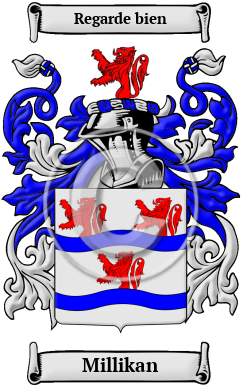
Motto: Regarde bien
Motto Translation: Look carefully.
- "What are the 5,000 Most Common Last Names in the U.S.?". NameCensus.com, https://namecensus.com/last-names/
- The Political Graveyard: Alphabetical Name Index. (Retrieved 2016, January 14) . Retrieved from http://politicalgraveyard.com/alpha/index.html
 |