| ![Show Contents]() Millicent History, Family Crest & Coats of Arms Millicent History, Family Crest & Coats of Arms
- Origins Available:
Ireland
Scotland
Etymology of MillicentWhat does the name Millicent mean? The Strathclyde-Briton people of ancient Scotland were the first to use the name Millicent. The Millicent family lived in Wigtown, a former royal burgh in the Machars of Galloway in the south west of Scotland. This burgh is first mentioned in an indenture of 1292, and the fact that the sheriffdom was in existence at the time of the Largs campaign of 1263 suggests that the burgh may also have been recognized as such during the reign of Alexander III. Early Origins of the Millicent familyThe surname Millicent was first found in Wigtownshire (Gaelic: Siorrachd Bhaile na h-Uige), formerly a county in southwestern Scotland, now part of the Council Area of Dumfries and Galloway, where they held a family seat from early times and their first records appeared on the early census rolls taken by the early Kings of Scotland to determine the rate of taxation of their subjects. Early History of the Millicent familyThis web page shows only a small excerpt of our Millicent research. Another 131 words (9 lines of text) covering the years 1296, 1526, 1612 and 1688 are included under the topic Early Millicent History in all our PDF Extended History products and printed products wherever possible. Millicent Spelling VariationsThe variation in the spelling of Medieval names is a result of the lack of spelling rules in the English language prior to the last few hundred years. Before that time, scribes spelled according to sound, often varying the spelling of name within a single document. Millicent has appeared as Milligan, Millicen, Millicken, Milliken, Milligan and many more. Early Notables of the Millicent familyMore information is included under the topic Early Millicent Notables in all our PDF Extended History products and printed products wherever possible. Migration of the Millicent family to IrelandSome of the Millicent family moved to Ireland, but this topic is not covered in this excerpt. More information about their life in Ireland is included in all our PDF Extended History products and printed products wherever possible.
| Millicent migration to the United States | + |
As the persecution of Clan families continued, they sailed for North America in increasing numbers. In most cases, they found the freedom and opportunity they sought. Land was often available and the American War of Independence allowed Scots an opportunity to solidify their independence from the English crown. These settlers and their ancestors went on to play essential roles in the forging of the nations of the United States and Canada. Among them:
Millicent Settlers in United States in the 17th Century- James Millicent, who landed in Virginia in 1653 1
| Contemporary Notables of the name Millicent (post 1700) | + |
- Violet Millicent Pinckney (1871-1955), English tennis player, winner of the German Championships in 1903
- Dorothy Millicent Horstmann (1911-2001), American epidemiologist, virologist and pediatrician, the first woman appointed as a professor at the Yale School of Medicine
- Amy Millicent Sowerby (1868-1967), prolific illustrator of children’s books
- Millicent Genevieve "Millie" Knight (b. 1999), British two-time gold, six-time silver medalist skier in the Paralympic Games and World Championships
- Millicent Taplin (1902-1980), British ceramicist who spent most of her career at Josiah Wedgwood and Sons (1917-1962)
- Millicent S. Ficken (1933-2020), American ornithologist who specialized in birds' vocalizations and their social behaviors
- Millicent Dolly May Small CD (1946-2020), Jamaican singer-songwriter, best known for her 1964 recording of "My Boy Lollipop"
- Millicent J. Osborn, American Republican politician, Member of New York Republican State Executive Committee, 1945 2
- Millicent Lilian "Peg" Entwistle (1908-1932), English stage and screen actress; she jumped to her death from the "H" on the Hollywoodland sign in September 1932, at the age of 24
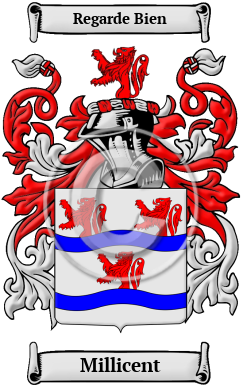
The motto was originally a war cry or slogan. Mottoes first began to be shown with arms in the 14th and 15th centuries, but were not in general use until the 17th century. Thus the oldest coats of arms generally do not include a motto. Mottoes seldom form part of the grant of arms: Under most heraldic authorities, a motto is an optional component of the coat of arms, and can be added to or changed at will; many families have chosen not to display a motto.
Motto: Regarde Bien
Motto Translation: Attend well.
- Filby, P. William, Meyer, Mary K., Passenger and immigration lists index : a guide to published arrival records of about 500,000 passengers who came to the United States and Canada in the seventeenth, eighteenth, and nineteenth centuries. 1982-1985 Cumulated Supplements in Four Volumes Detroit, Mich. : Gale Research Co., 1985, Print (ISBN 0-8103-1795-8)
- The Political Graveyard: Alphabetical Name Index. (Retrieved 2016, August 4) . Retrieved from http://politicalgraveyard.com/alpha/index.html
 |