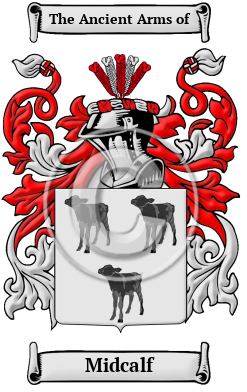
| ![Show Contents]() Midcalf History, Family Crest & Coats of Arms Midcalf History, Family Crest & Coats of Arms
Etymology of MidcalfWhat does the name Midcalf mean? The ancestors of the Midcalf surname lived among the ancient Anglo-Saxon culture. The name comes from when they lived in Yorkshire, where the family was found since the early Middle Ages. The name is of ancient Anglo-Saxon origin, deriving from two possible sources. Firstly, such Old English terms as mete-corn, meaning "corn for food," and mete-cu, meaning "cow that is to furnish food," make it conceivable that the name Midcalf is derived from an Old English word "mete-calf," meaning "a calf being fattened up for slaughtering." In this instance, the name would have been originally borne by a calf farmer. Alternatively, the name may come from Middleton Calf Top, a settlement on "The Calf," a hill located at the western boundary of Yorkshire; an early inhabitant of this settlement was known as Medecalf. Early Origins of the Midcalf familyThe surname Midcalf was first found in Yorkshire, where the first bearer of the name was said to be William Medecalf de Dent, who lived in Middleton Calf Top during the 12th century when the boundaries of the new counties of Westmorland, Cumberland, and Yorkshire West Riding were formed. The name also appeared on the census rolls where one of the earliest known bearers, Adam Medecalf, appeared in these rolls in 1301. There seems to be a historical relationships with the Turnbulls that goes back at least 500 years. In most cases the surnames were seen side by side as seen in the humorous quote: "Mr. Metcalf ran off on the meeting of a cow, With pale Mr. Turnbull behind him" 1 Another source claims this as the "traditional" origin of the name: "One John Strong having seized a mad bull by the nostrils with his left hand, killed the beast with his right, and being afterwards questioned on the subject of his prowess, modestly declared that he had simply met a calf. From that time he acquired the surname of Metcalf!" 2 This same source has another whimsical story: "Another version of the story is that 'two men being in the woods together at evening, seeing a four-footed animal coming towards them,' one said, 'Have you not heard of lions in these woods?' The other replied that he had, but had never seen any such thing. The animal coming near, one ran away, while the other resolved to meet it; which proving to be a red calf, he that met it got the name of Metcalfe, and he that ran away that of Lightfoot!" 2 There was a wide variety of spellings used by the family is the early days. The Yorkshire Poll Tax Rolls of 1379, include: Willelmus Miducroft; and Ricardus de Meducroft. Another authority claims "It is a remarkable fact that I cannot find Metcalf in the Yorkshire Poll Tax of of 1379. But the Meducrofts are there. Probably the corruption had not yet taken place." 1 By the 16th and 17th century, the name was "so numerous are they that there is scarcely a town or village in the North Riding [of Yorkshire] which cannot own an inhabitant of the name; in truth, in 1607 the Metcalfes were accounted the most numerous family in England; even in 1555 it is recorded that Sir Christopher Metcalfe, of Nappa Hall, near Askrigg, being High Sheriff of Yorkshire, was attended by 300 horsemen, all of his own family and name." 3 Early History of the Midcalf familyThis web page shows only a small excerpt of our Midcalf research. Another 84 words (6 lines of text) covering the years 1556, 1717, 1785, 1810, 1843, 1846 and 1890 are included under the topic Early Midcalf History in all our PDF Extended History products and printed products wherever possible. Midcalf Spelling VariationsBefore English spelling was standardized a few hundred years ago, spelling variations of names were a common occurrence. Elements of Latin, French and other languages became incorporated into English through the Middle Ages, and name spellings changed even among the literate. The variations of the surname Midcalf include Metcalfe, Medcalfe, Metcalf, Medcalf, Midkiff and many more. Early Notables of the Midcalf familySir Christopher Metcalfe (c.1556), High Sheriff of Yorkshire, who met the Judges of Assize in York on horseback with 300 mounted men of his own name and kindred, John Metcalf (1717-1810), known as Blind Jack of Knaresborough, a blind British engineer, athlete, and horseman who fought at Falkirk...
Another 47 words (3 lines of text) are included under the topic Early Midcalf Notables in all our PDF Extended History products and printed products wherever possible. Migration of the Midcalf family to IrelandSome of the Midcalf family moved to Ireland, but this topic is not covered in this excerpt.
Another 71 words (5 lines of text) about their life in Ireland is included in all our PDF Extended History products and printed products wherever possible. Migration of the Midcalf familyA great wave of immigration to the New World was the result of the enormous political and religious disarray that struck England at that time. Families left for the New World in extremely large numbers. The long journey was the end of many immigrants and many more arrived sick and starving. Still, those who made it were rewarded with an opportunity far greater than they had known at home in England. These emigrant families went on to make significant contributions to these emerging colonies in which they settled. Some of the first North American settlers carried this name or one of its variants: Christopher and James Metcalf, who both settled in Virginia in 1635; Elizabeth, Jane, John, Mary, Michael, Rebecca, Sarah and Thomas Metcalf, who all settled in Boston in 1637.
- Bardsley, C.W, A Dictionary of English and Welsh Surnames: With Special American Instances. Wiltshire: Heraldry Today, 1901. Print. (ISBN 0-900455-44-6)
- Lower, Mark Anthony, Patronymica Britannica, A Dictionary of Family Names of the United Kingdom. London: John Russel Smith, 1860. Print.
- Guppy, Henry Brougham, Homes of Family Names in Great Britain. 1890. Print.
 |