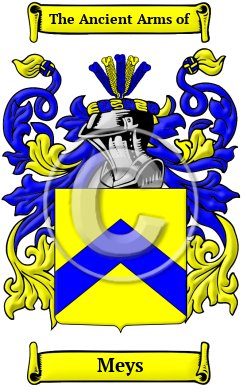
| ![Show Contents]() Meys History, Family Crest & Coats of Arms Meys History, Family Crest & Coats of Arms
- Origins Available:
France
Etymology of MeysWhat does the name Meys mean? The Meys family name dates back to the time of Medieval France. It comes from an early member of the family from Normandy who was a person born in the month of May. A May birth was considered lucky as the month was a festive time in which the beginning of the growing season was celebrated. Early Origins of the Meys familyThe surname Meys was first found in Normandy (French: Normandie), the former Duchy of Normandy, where the family anciently resided at Leme, a village in the department of l'Aisne, in the arrondisement of Vervins. By the 12th century the family name also moved south to Aquitaine and Languedoc. A branch was formed in Anjou at Poitiers. Michel Lemay, born in 1630, son of François and Marie (née Gaschet), travelled from Chenehutte-les-Tuffeaux in Anjou to New France in 1659. He settled in Quebec and married Marie Dutaut, born in 1640, daughter of Pierre and Jeanne, at Trois-Rivières on 15th June 1659. His second marriage was to Michelle Ouinville on 12th April 1677. 1 Early History of the Meys familyThis web page shows only a small excerpt of our Meys research. Another 103 words (7 lines of text) are included under the topic Early Meys History in all our PDF Extended History products and printed products wherever possible. Meys Spelling VariationsFrench surnames were subject to numerous spelling alterations depending on the region and time it was used. The early development of the French language relied heavily on borrowing elements and grammar from other languages. For example, Old French was infused with Germanic words and sounds when barbarian tribes invaded and settled in France after the fall of the Roman Empire. Middle French also borrowed heavily from the Italian language during the Renaissance. As a result of these linguistic and cultural influences, the name Meys is distinguished by a number of regional variations. The many spelling variations of the name include LeMay, Lemay, Lemais, Lemaise, Lemmais, Lemmaise, Lemaises, Lemet, Lemez, Lemait, Lemaits, Dumay, Dumais, Dumez and many more. Early Notables of the Meys familyMore information is included under the topic Early Meys Notables in all our PDF Extended History products and printed products wherever possible.
| Meys migration to the United States | + |
Approximately 110 years after the first landings by Cartier, there were only about 300 people in Quebec. France gave land incentives for 2,000 migrants during the next decade. Early marriage was desperately encouraged amongst the immigrants. The fur trade attracted migrants, both noble and commoner. 15,000 explorers left Montreal in the late 17th and 18th centuries. By 1675, there were 7000 French in Quebec. Migration to New France (Quebec) continued from France until it fell in 1759. In the year 1675 the Acadian presence in Nova Scotia, New Brunswick and Prince Edward Island had reached 500. In 1755, 10,000 French Acadians refused to take an oath of allegiance to England and were deported to Louisiana. The French founded Lower Canada, thus becoming one of the two great founding nations of Canada. The distinguished family name Meys has made significant contributions to the culture, arts, sciences and religion of France and New France. Amongst the settlers in North America with this distinguished name Meys were
Meys Settlers in United States in the 17th Century- Lawrence Meys, who landed in Maryland in 1670 2
Meys Settlers in United States in the 18th Century- Andres Meys, who landed in Pennsylvania in 1729 2
- Joh Jurg Meys, who arrived in Pennsylvania in 1753 2
- Olivier, Reginald L. Your Ancient Canadian Family Ties. Logan: The Everton Publishers, Inc., P.O. Box 368, 1972. Print
- Filby, P. William, Meyer, Mary K., Passenger and immigration lists index : a guide to published arrival records of about 500,000 passengers who came to the United States and Canada in the seventeenth, eighteenth, and nineteenth centuries. 1982-1985 Cumulated Supplements in Four Volumes Detroit, Mich. : Gale Research Co., 1985, Print (ISBN 0-8103-1795-8)
 |