
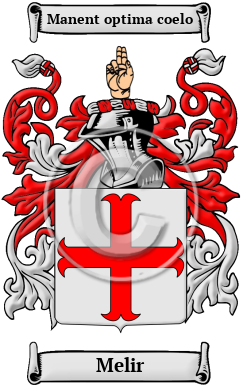
Show ContentsMelir History, Family Crest & Coats of Arms

Etymology of Melir

What does the name Melir mean?

A family of Strathclyde-Briton were the first to use the name Melir. They lived in the county of Dumfries.

Early Origins of the Melir family

The surname Melir was first found in Dumfriesshire (Gaelic: Siorrachd Dhùn Phris), a Southern area, bordering on England that today forms part of the Dumfries and Galloway Council Area, where the Melir family held a family seat from ancient times. One line had its ancestral seat at Dalswinton, Dumfriesshire. During the Middle Ages, occupational names were frequently recorded in Latin; thus, one who worked at a mill would have been documented under the name Milendinarius, Le Molendinator, or De Molendino. The modern spellings "Miller" and "Millar" came into general use about 1500; earlier documents usually show the name in Latin.

Early History of the Melir family

This web page shows only a small excerpt of our Melir research. Another 130 words (9 lines of text) covering the years 1253, 1650 and 1750 are included under the topic Early Melir History in all our PDF Extended History products and printed products wherever possible.

Melir Spelling Variations

In the era before dictionaries, there were no rules governing the spelling or translation of names or any other words. Consequently, there are an enormous number of spelling variations in Medieval Scottish names. Melir has appeared as Miller, Millar, Myllar, Mylar, Millare, Myllair and many more.

Early Notables of the Melir family

More information is included under the topic Early Melir Notables in all our PDF Extended History products and printed products wherever possible.

Migration of the Melir family to Ireland

Some of the Melir family moved to Ireland, but this topic is not covered in this excerpt.
Another 45 words (3 lines of text) about their life in Ireland is included in all our PDF Extended History products and printed products wherever possible.

Migration of the Melir family

The freedom, opportunity, and land of the North American colonies beckoned. There, Scots found a place where they were generally free from persecution and where they could go on to become important players in the birth of new nations. Some fought in the American War of Independence, while others went north to Canada as United Empire Loyalists. The ancestors of all of these Scottish settlers have been able to recover their lost national heritage in the last century through highland games and Clan societies in North America. Among them: John Millar, who arrived in St. John's, Newfoundland in 1705; Daniel Millar, who settled in Maryland in 1714; George Millar, who was recorded as a runaway servant, convict, or slave in Delaware in 1754.


The Melir Motto +

The motto was originally a war cry or slogan. Mottoes first began to be shown with arms in the 14th and 15th centuries, but were not in general use until the 17th century. Thus the oldest coats of arms generally do not include a motto. Mottoes seldom form part of the grant of arms: Under most heraldic authorities, a motto is an optional component of the coat of arms, and can be added to or changed at will; many families have chosen not to display a motto.

Motto: Manent optima coelo
Motto Translation: The best things await us in heaven.


Houseofnames.com on Facebook