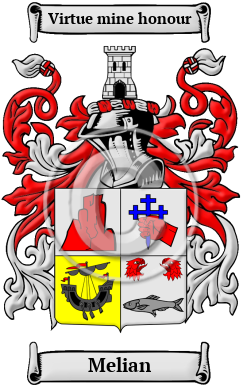
| ![Show Contents]() Melian History, Family Crest & Coats of Arms Melian History, Family Crest & Coats of Arms
Etymology of MelianWhat does the name Melian mean? On the Scottish west coast, the Melian family was born among the ancient Dalriadan clans. Their name comes from a devotion to St. John. The surname is an Anglicized form of the Gaelic Mac Gille Eathain, a patronymic name meaning "son of the servant of Saint John." The Clan is descended from Eachan Reaganach, (brother of Lachlan the progenitor of the Macleans of Duart). These two brothers were both descended from Gilleathain na Tuaidh, known as 'Gillian of the Battleaxe', a famed warrior of the 5th century. Eachan, or Hector was given the lands of Lochbuie from John, the first Lord of the Isles, some time in the 14th century. Melian Coat of Arms CreationThe Macleans claim descent from one Gill-Eathain na Tuaighe, so called from his carrying as his ordinary weapon a battle-axe ; and they have for their crest a battle-axe surrounded by a laurel or cypress branch. This they are said to have adopted from the following incident in their founder's career : Gill-Eathain was engaged, with others, in a stag hunt at Beinn Talaidh in Mull, and wandered away from the rest of the party in pursuit of his quarry. The mountain suddenly became enveloped in mist and he lost his way. For three days he wandered about unable to recover his track. On the fourth day, utterly exhausted, he crept under a laurel bush, where, after fixing the handle of the battle-axe in the earth, he lay down and slept. On the evening of that day his friends saw the head of the battle-axe above the bush, and found Gill-Eathain alseep on the ground with his arm round the handle. This clan has two slogans, " Bets no beatha " (Death or life), and "Another for Hector." The second slogan had its origin in an incident, at the battle of Inverkeithing in 1651, which demonstrates the devotion of the clansmen to their chief. In July of that year Cromwell's forces, under General Lambert, opposed the Scots army, under Holborn of Menstrie. Holborn with his cavalry fled soon after the battle began. Sir Hector Roy Maclean of Duart was there with 800 men. They were encircled by the English and were being cut to pieces. Sir Hector's clansmen saw that the English objective was to get their chief. They therefore flocked round him, and at every attempt on their chief's life a clansman threw himself upon the enemy and fell, one after the other exclaiming " Another for Hector " until eight Macleans lay dead ere Sir Hector himself fell. 1 Early Origins of the Melian familyThe surname Melian was first found in the Western Isles where the Clan held extensive lands on almost every island in the Western Hebrides. Early History of the Melian familyThis web page shows only a small excerpt of our Melian research. Another 139 words (10 lines of text) covering the years 1310, 1320, 1370, 1411, 1500, 1560, 1582, 1604, 1620, 1630, 1645, 1649, 1650, 1651, 1658, 1666, 1670, 1674, 1687, 1716, 1745 and 1890 are included under the topic Early Melian History in all our PDF Extended History products and printed products wherever possible. Melian Spelling VariationsIn the Middle Ages, the translation between Gaelic and English was not a highly developed process. Spelling was not yet standardized, and so, an enormous number of spelling variations appear in records of early Scottish names. Melian has appeared as MacLean, MacLaine, MacLane, MacLeane, MacClean, MacClain, MacClaine, MacGhille Eoin (Gaelic) and many more. Early Notables of the Melian familyHector MacLean, Lord of Dowart (c.1560-c.1630), Scottish Lord of the Clan MacLean; Francis Cleyn (Clein, Franz Klein) (c. 1582-1658), a painter and tapestry designer; Sir John Maclean, 1st Baronet, (1604-1666); Sir Hector Maclean, 2nd Baronet of Morvern (c.1620-1651), the 18th Clan Chief of Clan Maclean from 1649 to 1651; Sir Allan Maclean, 3rd Baronet of Morvern (1645-1674)...
Another 56 words (4 lines of text) are included under the topic Early Melian Notables in all our PDF Extended History products and printed products wherever possible. Migration of the Melian family to IrelandSome of the Melian family moved to Ireland, but this topic is not covered in this excerpt.
Another 67 words (5 lines of text) about their life in Ireland is included in all our PDF Extended History products and printed products wherever possible.
| Melian migration to the United States | + |
These settlers arrived in North America at a time when the east was burgeoning with prosperous colonies and the expanses of the west were just being opened up. The American War of Independence was also imminent. Some Scots stayed to fight for a new country, while others who remained loyal went north as United Empire Loyalists. The ancestors of all of them went on to rediscover their heritage in the 20th century through highland games and other patriotic Scottish events. The Melian were among these contributors, for they have been located in early North American records:
Melian Settlers in United States in the 19th Century- Angel Melian, aged 46, who landed in Puerto Rico in 1857 2
- Cecilia Melian, who arrived in Puerto Rico in 1857 2
- Francisco Melian, who landed in Puerto Rico in 1857 2
- Gervasio Melian, who arrived in Puerto Rico in 1857 2
- Saturnina Melian, who landed in Puerto Rico in 1857 2
| Contemporary Notables of the name Melian (post 1700) | + |
- Manuel Amor Melián (b. 1867), Spanish poet, journalist and editor
- Mrs. Melian Barbara Mansfield M.B.E. (b. 1942), British recipient of Member of the Order of the British Empire on 8th June 2018, for services to Young People, Play and Education 3
The motto was originally a war cry or slogan. Mottoes first began to be shown with arms in the 14th and 15th centuries, but were not in general use until the 17th century. Thus the oldest coats of arms generally do not include a motto. Mottoes seldom form part of the grant of arms: Under most heraldic authorities, a motto is an optional component of the coat of arms, and can be added to or changed at will; many families have chosen not to display a motto.
Motto: Virtue mine honour
Motto Translation: Virtue is my honour.
- Polson, Alexander, The Romance of Scottish Crests and Mottoes. Inverness: Walter Alexander, Inglis Street 1929. Print
- Filby, P. William, Meyer, Mary K., Passenger and immigration lists index : a guide to published arrival records of about 500,000 passengers who came to the United States and Canada in the seventeenth, eighteenth, and nineteenth centuries. 1982-1985 Cumulated Supplements in Four Volumes Detroit, Mich. : Gale Research Co., 1985, Print (ISBN 0-8103-1795-8)
- "Birthday and New Year Honours Lists (1940 to 2019)." Issue 62310, 4 July 2019 | London Gazette, The Gazette, June 2018, https://www.thegazette.co.uk/London/issue/62310/supplement/B1
 |