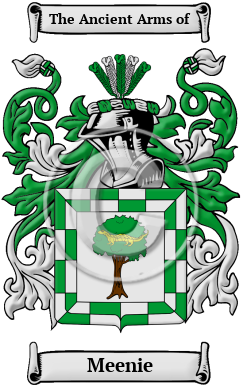
| ![Show Contents]() Meenie History, Family Crest & Coats of Arms Meenie History, Family Crest & Coats of Arms
- Origins Available:
Ireland
Etymology of MeenieWhat does the name Meenie mean? Gaelic, otherwise known as Early Modern Irish, was used in Ireland from around the year 1200 until the 18th century. It is from this language that we found the first references to the name Meenie as Ó Maonaigh. This is derived from the word maonach, meaning wealthy. 1 Early Origins of the Meenie familyThe surname Meenie was first found in County Offaly (Irish: Uíbh Fháilí) originally the Kingdom of Uí Failghe, located in central Ireland in the Province of Leinster, where they held a family seat from ancient times. Early History of the Meenie familyThis web page shows only a small excerpt of our Meenie research. Another 66 words (5 lines of text) are included under the topic Early Meenie History in all our PDF Extended History products and printed products wherever possible. Meenie Spelling VariationsPronunciation, rather than spelling, guided scribes and church officials when recording names during the Middle Ages. This practice often resulted in one person's name being recorded under several different spellings. Numerous spelling variations of the surname Meenie are preserved in these old documents. The various spellings of the name that were found include Mooney, Moony, O'Mooney, Meeny, O'Meany, Meany, O'Meeny, O'Mainy, Meaney and many more. Early Notables of the Meenie familyMore information is included under the topic Early Meenie Notables in all our PDF Extended History products and printed products wherever possible. Migration of the Meenie familyDuring the 19th century thousands of impoverished Irish families made the long journey to British North America and the United States. These people were leaving a land that had become beset with poverty, lack of opportunity, and hunger. In North America, they hoped to find land, work, and political and religious freedoms. Although the majority of the immigrants that survived the long sea passage did make these discoveries, it was not without much perseverance and hard work: by the mid-19th century land suitable for agriculture was short supply, especially in British North America, in the east; the work available was generally low paying and physically taxing construction or factory work; and the English stereotypes concerning the Irish, although less frequent and vehement, were, nevertheless, present in the land of freedom, liberty, and equality for all men. The largest influx of Irish settlers occurred with Great Potato Famine during the late 1840s. Research into passenger and immigration lists has brought forth evidence of the early members of the Meenie family in North America: Andrew, Arthur, Catherine, Daniel, Hugh, James, John, Mary, Michael, Patrick, Richard, Thomas and William Mooney all arrived in Philadelphia, Pennsylvania between 1840 and 1860.
- MacLysaght, Edward, The Surnames of Ireland. Ireland: Irish Academic Press, sixth edition, 1985. Print. (ISBN 0-7165-2366-3)
 |