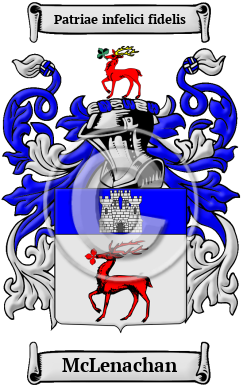
The Anglo-Norman Conquest of Ireland lead by Strongbow introduced the first non-Gaelic elements into Irish nomenclature. These Anglo-Normans brought some traditions to Ireland that were not readily found within Gaelic system of hereditary surnames. One of the best examples of this is the local surname. Local surnames, such as McLenachan, were taken from the name of a place or a geographical feature where the person lived, held land, or was born. These surnames were very common in England, but were almost non-existent within Ireland previous to the conquest. Originally, these place names were prefixed by "de," which means "from" in French. This type of prefix was eventually either made a part of the surname, if the place name began with a vowel, or was eliminated entirely. The McLenachan family originally lived in the settlement of Llanaghan, which is in the Welsh county of Brecon.
Loading...
Early Origins of the McLenachan family
The surname McLenachan was first found in County Roscommon (Irish: Ros Comáin) located in central Ireland in the province of Connacht, where they were granted lands by Strongbow after his invasion of Ireland in 1172.
Early History of the McLenachan family
This web page shows only a small excerpt of our McLenachan research. Another 85 words (6 lines of text) covering the year 1249 is included under the topic Early McLenachan History in all our PDF Extended History products and printed products wherever possible.
McLenachan Spelling Variations
During the lifetime of an individual person, his name was often spelt by church officials and medieval scribes the way it sounded. An examination of the many different origins of each name has revealed many spelling variations for the name: Lanigan, Lanahan, Lenaghan, Lanaghan, Linehan and many more.
Early Notables of the McLenachan family
More information is included under the topic Early McLenachan Notables in all our PDF Extended History products and printed products wherever possible.
Loading...
Loading...
Loading...
Loading...
Migration of the McLenachan family
In the mid-19th century, Ireland experienced one of the worst periods in its entire history. During this decade in order to ease the pressure of the soil, which was actually depleted by the effects of the previous years' grain crops, landowners forced tenant farmers and peasants onto tiny plots of land that barely provided the basic sustenance a family required. Conditions were worsened, though, by the population of the country, which was growing fast to roughly eight million. So when the Great Potato Famine of the mid-1840s hit, starvation and diseases decimated the population. Thousands of Irish families left the country for British North America and the United States. The new immigrants were often accommodated either in the opening western frontiers or as cheap unskilled labor in the established centers. In early passenger and immigration lists there are many immigrants bearing the name McLenachan: Michael Lanagan, who came to Newfoundland in 1814; Edward Lanaghan, who arrived at St. John, New Brunswick in 1834; Cornelius, Biddy and George Lanagan, who all arrived in Philadelphia in 1828.
The motto was originally a war cry or slogan. Mottoes first began to be shown with arms in the 14th and 15th centuries, but were not in general use until the 17th century. Thus the oldest coats of arms generally do not include a motto. Mottoes seldom form part of the grant of arms: Under most heraldic authorities, a motto is an optional component of the coat of arms, and can be added to or changed at will; many families have chosen not to display a motto.
Motto: Patriae infelici fidelis Motto Translation: Faithful to an unhappy country.
Remove Item
WARNING!
Removing this item from your shopping cart will remove your associated sale items.
Are you sure you want to delete this item from your shopping cart?
HouseofNames E-Newsletter Sign Up
On Demand Gifts | Digital Products Available 24/7
A Gift for Everyone on your List is a Click Away - Shop Now