| ![Show Contents]() McGivery History, Family Crest & Coats of Arms McGivery History, Family Crest & Coats of Arms
- Origins Available:
Scotland
Etymology of McGiveryWhat does the name McGivery mean? The background history of the name McGivery starts in ancient Scotland among the Pictish people. The name McGivery is derived from a personal name meaning servant of judgement. The Gaelic form of the name is Mac Gillebhrath. Early Origins of the McGivery familyThe surname McGivery was first found in Argyllshire (Gaelic erra Ghaidheal), the region of western Scotland corresponding roughly with the ancient Kingdom of Dál Riata, in the Strathclyde region of Scotland, now part of the Council Area of Argyll and Bute, but this family seat was later moved to Iona with the advent of St. Columba. From this original descendancy came Giolla Brighid, known also as Gillibride, or Gillivray. Gillivray's son, Somerled, the 8th and greatest Thane of Argyll, Lord of Kintyre, and founder of the 'Kingdom of the Isles' was instrumental in driving out the invading Norse (Vikings) from his Kingdom, commencing in 1140 AD. However, Somerled, still gave allegiance to the King of Vikings which continued until 1222, long after Somerled's death in 1164 AD. At this time, Alexander II of Scotland routed many of the Clans 'of the Isles', leaving them eastern Scotland in an area from Glasgow north to Inverness to the East Coast. The MacGillivrays were moved northwards to Lochabe. They became closely associated with their neighbors, the McInnises, the McMasters, and the MacEacherns. They also joined the great Pictish confederacy of Clans known as the Clan Chattan, an association of some twenty six Clans, during the time of Ferquhard, 5th Chief of the MacKintosh, and Chief of the Clan Chattan. Early History of the McGivery familyThis web page shows only a small excerpt of our McGivery research. Another 327 words (23 lines of text) covering the years 1467, 1535, 1542, 1550, 1688, 1745 and 1822 are included under the topic Early McGivery History in all our PDF Extended History products and printed products wherever possible. McGivery Spelling VariationsPrior to the invention of the printing press in the last hundred years, documents were basically unique. Names were written according to sound, and often appeared differently each time they were recorded. Spelling variations of the name McGivery include MacGillivray, MacGillivery, MacGillivary, MacGillivry, MacIlvray, MacIlvrae, MacIlwrach, MacIlwray, MacGivery, MacGivray, McGillivrae and many more. Early Notables of the McGivery familyMacGillivray of Dunmaglass. The Hon. William McGillivray, son of Donald McGillivray of Dalscoilte, near Dunmaglass, was the head of the NorthWest Company fur trading consortium in Montreal, Canada. He purchased the old...
Another 31 words (2 lines of text) are included under the topic Early McGivery Notables in all our PDF Extended History products and printed products wherever possible. Migration of the McGivery familyThe freedom of the North American colonies was enticing, and many Scots left to make the great crossing. It was a long and hard journey, but its reward was a place where there was more land than people and tolerance was far easier to come by. Many of these people came together to fight for a new nation in the American War of Independence, while others remained loyal to the old order as United Empire Loyalists. The ancestors of Scots in North America have recovered much of this heritage in the 20th century through Clan societies and other such organizations. A search of immigration and passenger lists revealed many important and early immigrants to North America bearing the name of McGivery: Alexander, Donald, Fargus, James, John, Loughlin, Owen, and William MacGillivray, who all arrived in South Carolina in 1716; Donald McGillivray, who settled in Ontario in 1794.
The motto was originally a war cry or slogan. Mottoes first began to be shown with arms in the 14th and 15th centuries, but were not in general use until the 17th century. Thus the oldest coats of arms generally do not include a motto. Mottoes seldom form part of the grant of arms: Under most heraldic authorities, a motto is an optional component of the coat of arms, and can be added to or changed at will; many families have chosen not to display a motto.
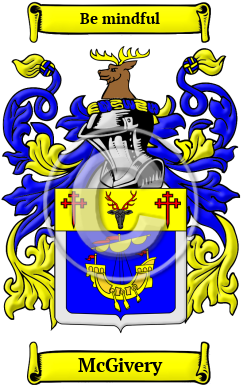
Motto: Be mindful
 |