| ![Show Contents]() McFarline History, Family Crest & Coats of Arms McFarline History, Family Crest & Coats of Arms
- Origins Available:
Scotland
Ireland
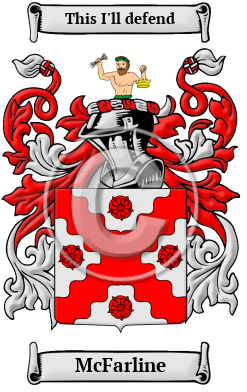
Etymology of McFarlineWhat does the name McFarline mean? The many centuries old Dalriadan-Scottish name McFarline comes from the personal name Parlan, which is the Gaelic equivalent of Bartholomew. The Gaelic form of the name is Mac Pharlain. 1 McFarline Coat of Arms CreationIn clan fights the MacFarlanes were generally on the losing side, but at the battle of Langside they were instrumental in turning the tide of battle at the crucial moment. It is told that MacFarlane came up with three hundred of his men, and, falling on the flank of the Queen's army, threw them into disorder, and thus contributed to the deciding of the fortunes of the day. The MacFarlanes captured three of Queen Mary's standards in the fray. The chief's reward was not a very tangible one, and is scarcely creditable to the Regent Moray, being merely a crest which flattered his vanity, a demi-savage holding in his right hand a sheaf of arrows and pointing with his left to an imperial crown. The motto borne upon a scroll above the head of the savage is " This I'll defend." 2 Early Origins of the McFarline familyThe surname McFarline was first found in Aberdeenshire (Gaelic: Siorrachd Obar Dheathain), a historic county, and present day Council Area of Aberdeen, located in the Grampian region of northeastern Scotland, where they were descended from the ancient Chief Allan, son of Farlane and settled in Strathdonn in Aberdeenshire about the 9th century. This Clan was originally known as the Clan Allan. Official documentation is derived from Gilchrist MacFarlane who was brother of Maldowen, third of the ancient Earls of Lennox in the 13th century. Grandson of Gilchrist was Parlan, the first of the Clan so named. Duncan, sixth Chief of the Clan obtained the lands of Arrochar in 1395. They supported the Earls of Lennox at the Battle of Pinkie, and they also distinguished themselves at the Battle of Langside, fighting against Queen Mary and capturing three of the Queen's standards. 3 The MacFarlane Clan acquired the lands of Arrochar from the Earl of Lennox in the late 14th century. The chief, Duncan, gained many of the surrounding lands through marriage in 1395 and claimed the title of Earl of Lennox upon the death of the old Earl, who had left no male heir. In fact, the MacFarlanes had a reasonable claim to the Earldom of Lennox, for which they fought so strenuously, for their eponymous ancestor was Parlan, the great-grandson of Gilchrist. His brother had been Maldowen, the third of the ancient earls of Lennox during the 13th century. When the title of Earl was conferred upon Sir John Stewart, a bitter feud ensued between the MacFarlanes and the Stewarts, which lasted until the 15th century. Interestingly, in the next century, the warlike MacFarlanes became supporters of their erstwhile foes and distinguished themselves in many battles. However, by the 17th century, the Clan was outlawed and became scattered, with some members immigrating to Ireland and later to America. Early History of the McFarline familyThis web page shows only a small excerpt of our McFarline research. Another 59 words (4 lines of text) covering the years 1705, 1734, 1758, 1767, 1768, 1771, 1791, 1792, 1804, 1832, 1857 and 1890 are included under the topic Early McFarline History in all our PDF Extended History products and printed products wherever possible. McFarline Spelling VariationsSpelling and translation were not standardized practices until the last few centuries. Spelling variations are extremely common among early Scottish names. McFarline has been spelled MacFarlane, MacFarlain, MacFarlan, MacFarland, MacParlan, MacParland, MacPartland, MacPartlin, MacPharlane, MacPharlin, MacPharlan and many more. Early Notables of the McFarline familyWalter MacFarlan (d. 1767), antiquary, second son of John Macfarlan of Arrochar and Helen, daughter of Robert, second viscount Arbuthnot, succeeded his father in 1705. From his early years Macfarlan devoted himself to antiquarian research connected with the history of Scotland. Ecclesiastical records specially attracted him, and he employed a clerk named Tait to make copies of most of the cartularies accessible to him; the copies are notable for their accuracy and neatness. Macfarlan appears to have held strict views on etiquette. 4
Duncan MacFarlane (1771-1857), principal of Glasgow University, son of Duncan Macfarlane, minister of Drymen, Stirlingshire, was born at Auchingray...
Another 197 words (14 lines of text) are included under the topic Early McFarline Notables in all our PDF Extended History products and printed products wherever possible. Migration of the McFarline family to IrelandSome of the McFarline family moved to Ireland, but this topic is not covered in this excerpt.
Another 87 words (6 lines of text) about their life in Ireland is included in all our PDF Extended History products and printed products wherever possible.
| McFarline migration to Canada | + |
Many who arrived from Scotland settled along the east coast of North America in communities that would go on to become the backbones of the young nations of the United States and Canada. In the American War of Independence, many settlers who remained loyal to England went north to Canada as United Empire Loyalists. Their descendants later began to recover the lost Scottish heritage through events such as the highland games that dot North America in the summer months. Research into various historical records revealed some of first members of the McFarline family emigrate to North America: McFarline Settlers in Canada in the 19th Century- Mary McFarline, aged 24, who arrived in Saint John, New Brunswick in 1834 aboard the brig "Betsy Heron" from Belfast, Ireland
| McFarline Motto and War Cry | + |
The motto was originally a war cry or slogan. Mottoes first began to be shown with arms in the 14th and 15th centuries, but were not in general use until the 17th century. Thus the oldest coats of arms generally do not include a motto. Mottoes seldom form part of the grant of arms: Under most heraldic authorities, a motto is an optional component of the coat of arms, and can be added to or changed at will; many families have chosen not to display a motto.
Motto: This I'll defend
War Cry: "Loch Sloy, Loch Sloy"
War Cry Description: Their gathering place was a small lake near the base of Ben Voirlich, and from it they took their war cry, "Loch Sloy, Loch Sloy," a. name which means "the lake of the host."
- Black, George F., The Surnames of Scotland Their Origin, Meaning and History. New York: New York Public Library, 1946. Print. (ISBN 0-87104-172-3)
- Polson, Alexander, The Romance of Scottish Crests and Mottoes. Inverness: Walter Alexander, Inglis Street 1929. Print
- Arthur, William , An Etymological Dictionary of Family and Christian Names. London: 1857. Print
- Smith, George (ed), Dictionary of National Biography. London: Smith, Elder & Co., 1885-1900. Print
 |