| ![Show Contents]() McCreith History, Family Crest & Coats of Arms McCreith History, Family Crest & Coats of Arms
- Origins Available:
Scotland
Ireland
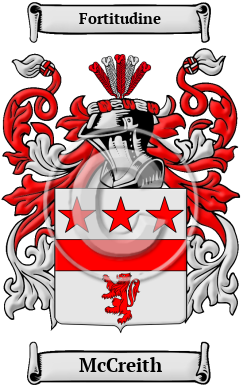
Etymology of McCreithWhat does the name McCreith mean? The clans of the Pictish people in ancient Scotland were the ancestors of the first people to use the name McCreith. It was a name for a prosperous person. The Gaelic form of the surname McCreith is Mac Rath, which literally means son of grace or son of prosperity. McCreith Coat of Arms CreationNearly three centuries ago there was a great bagpipe competition held in Kintail, the home of the Macraes, and pipers from far and near came to compete. The supreme test was to play a particular tune all the way up to the top of a hill in the neighbourhood. Two of the competitors were nearing the top together, but one of them, a Macrae, was a step or two in front of his rival, who, in his chagrin, pulled out his dagger and pricked the other's bagpipe; but Macrae managed to get his foot on the topmost rock just as the wind failed, and exclaimed " Sguir-oran," which is now the name of this hill and the slogan of the Macraes. From this incident the Macraes then took for their crest a bared right arm with the hand holding a dagger, and the motto " Fortitudine " (with fortitude). Early Origins of the McCreith familyThe surname McCreith was first found in Inverness-shire (Gaelic: Siorrachd Inbhir Nis) divided between the present day Scottish Council Areas of Highland and Western Isles, and consisting of a large northern mainland area and various island areas off the west coast, the shire was anciently both a Pictish and Norwegian stronghold, but their ancient history is often clouded with conjecture. It appears certain that they lived before the 14th century at Clunes, to the west of Inverness in the territories of the Fraser Clan. Consequently the family has always been friendly towards that Clan. From about 1400, they moved to the location with which they are readily associated, Kintail. Early History of the McCreith familyThis web page shows only a small excerpt of our McCreith research. Another 548 words (39 lines of text) covering the years 1296, 1425, 1477, 1505, 1539, 1688, 1715, 1745, 1764, 1778 and 1890 are included under the topic Early McCreith History in all our PDF Extended History products and printed products wherever possible. McCreith Spelling VariationsIn the Middle ages, spelling and translation were not yet regulated by any general rules. spelling variations in names were common even among members of one family unit. McCreith has appeared MacCrae, MacCraith, MacCrath, MacCraw, MacCray, MacCrea, MacCree, MacCreight, MacCrie, MacReagh, MacRae, MacRay, MacRie and many more. Early Notables of the McCreith familyFinghin MacCarthy Reagh (c.1425-1505), the 8th Prince of Carbery from 1477 to 1505, belonged to the MacCarthy Reagh dynasty; the Earl of Seaforth who forfeited his lands in 1715, but in 1764 was allowed to buy the lands back from the Government. In gratitude he offered to raise a regiment to be known as the Seaforth Highlanders (the 78th Regiment). Composed largely of MacKenzies and MacRaes (always loyal supporters of the MacKenzies whose Chief commanded the Regiment), it was embodied at Elgin in May 1778. In August, they marched to Leith for embarkation...
Another 92 words (7 lines of text) are included under the topic Early McCreith Notables in all our PDF Extended History products and printed products wherever possible. Migration of the McCreith family to IrelandSome of the McCreith family moved to Ireland, but this topic is not covered in this excerpt.
Another 59 words (4 lines of text) about their life in Ireland is included in all our PDF Extended History products and printed products wherever possible. Migration of the McCreith familyFaced by this persecution and the generally unstable political climate of those days, many Scots chose to leave their homeland for Ireland, Australia, and North America in search of greater opportunity and freedom. The colonies across the Atlantic were the most popular choice, but a passage there was neither cheap nor easily suffered. Passengers arrived sick and poor, but those who made it intact often found land and more tolerant societies in which to live. These brave settlers formed the backbone of the burgeoning nations of Canada and the United States. It is only this century that the ancestors of these families have begun to recover their collective identity through the patriotic highland games and Clan societies that have sprung up throughout North America. Research into early immigration and passenger lists revealed many immigrants bearing the name McCreith: Hugh MacCrae settled in New York in 1774; James, Daniel, Henry, John, Patrick, Robert, William MacCrea all arrived in Philadelphia between 1800 and 1870.
The motto was originally a war cry or slogan. Mottoes first began to be shown with arms in the 14th and 15th centuries, but were not in general use until the 17th century. Thus the oldest coats of arms generally do not include a motto. Mottoes seldom form part of the grant of arms: Under most heraldic authorities, a motto is an optional component of the coat of arms, and can be added to or changed at will; many families have chosen not to display a motto.
Motto: Fortitudine
Motto Translation: With fortitude.
 |