| ![Show Contents]() Maxime History, Family Crest & Coats of Arms Maxime History, Family Crest & Coats of Arms
- Origins Available:
England
Scotland
Etymology of MaximeWhat does the name Maxime mean? The surname Maxime is a habitation name, adopted from the name of the Parish of Maxton, in the Scottish Borders. The Parish name is believed to come from the "tun" or "homestead" of Maccus, believed to have been a Saxon settler, he is recorded as living in the area in 1116. The place name has appeared written as Mackeston, Mackiston, Maxston, Maxtun, Maccuston, Maxtoun and eventually as Maxton in 1580. 1 Early Origins of the Maxime familyThe surname Maxime was first found in Roxburghshire, where they held a family seat in their territories. The Norman influence on Scottish history considerably influenced the crown and government in the period between King Malcolm Ceanmore (1058-1093) and King David (1124-1153). Many Norman nobles were either invited or escaped into Scotland following the example of Margaret, wife of Malcolm Ceanmore, who actively recruited these Normans to their court. Maccus, son of Undewyn was believed to have followed King David north and was granted the lands of Maxton. "About the year 1250 Adam de Makuston witnessed a charter by John de Normanville), and about the same period John, son of Philip de Mackuston, quitclaimed to the monks of Melrose the right of pastere in his territory. Adam de Maxton was elected abbot of Melrose in 1261." 1 Other early instances of the name include Adam de Macston, 17th Abbot of Melrose, and Peter of Makeston, who held a family seat in Huntingdon in 1200. Later Maxton passed to the Berkleys then to the Normanvilles. Early History of the Maxime familyThis web page shows only a small excerpt of our Maxime research. Another 163 words (12 lines of text) covering the years 1285, 1296, 1725 and 1745 are included under the topic Early Maxime History in all our PDF Extended History products and printed products wherever possible. Maxime Spelling VariationsSpelling variations of this family name include: Maxton, Maxtone, Mackston, Makston, Makeston, Maxston, Maxon, Mackson and many more. Early Notables of the Maxime familyMore information is included under the topic Early Maxime Notables in all our PDF Extended History products and printed products wherever possible. Migration of the Maxime familySome of the first settlers of this family name or some of its variants were: Richard Maxson, who came to Boston in 1634; Samuel Maxson, who came to San Francisco in 1850; Alexander Maxton, who arrived in Montreal in 1839; Andrew Maxton, who came to Georgia in 1759.
| Contemporary Notables of the name Maxime (post 1700) | + |
- Sir Paul Maxime Nurse PRS (b. 1949), British geneticist and cell biologist co-winner of the 2001 Nobel Prize in Physiology or Medicine
- Maxime Gingras (b. 1978), Canadian ice hockey player
- Maxime Gingras (b. 1984), Canadian freestyle skier at the 2010 Winter Olympics
- Maxime Pedneaud-Jobin (b. 1968), Canadian politician, Mayor of Gatineau
- Maxime Weygand (1867-1965), Belgium-born, French military commander in World War I and World War II, he was raised in France and educated at the Saint-Cyr military academy in Paris, Chief of Staff of the French Army, a position he served until his retirement in 1935 at the age of 68
- Maxime Le Forestier (b. 1949), French singer-songwriter
- Maxime Delauney (b. 1981), French actor, born at Saint Lô, Manche, Basse-Normandie, France, known for La femme de Rio (2013), Collection rue des ravissantes: Boris Vian fait son cinéma (2014) and No Limit (2022)
- Maxime Bernier (b. 1963), Canadian politician and cabinet minister, Leader of the People's Party of Canada (2018-)
- Maxime Laoun (b. 1996), Canadian short-track speed skater, gold medalist at the 2022 Winter Olympics
The motto was originally a war cry or slogan. Mottoes first began to be shown with arms in the 14th and 15th centuries, but were not in general use until the 17th century. Thus the oldest coats of arms generally do not include a motto. Mottoes seldom form part of the grant of arms: Under most heraldic authorities, a motto is an optional component of the coat of arms, and can be added to or changed at will; many families have chosen not to display a motto.
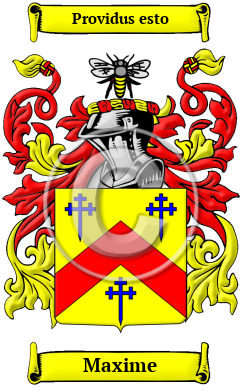
Motto: Providus esto
Motto Translation: Be thou circumspect.
- Black, George F., The Surnames of Scotland Their Origin, Meaning and History. New York: New York Public Library, 1946. Print. (ISBN 0-87104-172-3)
 |