| ![Show Contents]() Mathisen History, Family Crest & Coats of Arms Mathisen History, Family Crest & Coats of Arms
Etymology of MathisenWhat does the name Mathisen mean? The age-old Hebrides islands and the west coast of Scotland are the ancestral home of the Mathisen family. Their name comes from the son of Matthew. 1 In Gaelic, the name was spelled M'Mhathain or Mathanach. The latter names in Gaelic were probably derived from Mac Mhathghamhuin which means son of the bear. Indeed, early references of the name have reference to the Scottish bear. 2 3 Today, early legal records provide a plethora of information about the family with various early spellings. Some of the first records include, "Robertus filius Mathei [who] witnessed a charter by Walter filius Alani, a. 1177. John Mathyson and Michael Mathowson were outlawed as part guilty of the slaughter of Walter de Ogilvy, Sheriff of Angus, in 1392." 3 Early Origins of the Mathisen familyThe surname Mathisen was first found in the Scottish Highlands were they could be found in Lochalsh, Lochcarron and Kintail. They are said to descend from Gilleoin of the ancient and royal house of Lorne. They gave their allegiance to the Clan MacDonald, the Lord of the Isles. Kenneth MacMathan (Cormac Mac Mathian) was the constable of Eilean Donan castle and is recorded in most accounts of the invasion of King Haakon IV of Norway against Scotland in the 13th century. One accounts suggests that McMathan and his clansmen fought under the Earl of Ross, defeating Haaken at Largs in 1263. There is a record of Kermac Macmaghan in Inverness, receiving 20 cows from the Earl of Ross in 1264. "In the Norse Saga he is called Kjarmak son of Makamal = Corniac Macmathan. The Siol Mhathain, a sept of Matheson, in an old Gaelic song appears as Siol Mhothan. Matheson has been adopted as the English form of the name simply on account of the similarity of sound." 3 Early History of the Mathisen familyThis web page shows only a small excerpt of our Mathisen research. Another 418 words (30 lines of text) covering the years 1263, 1400, 1411, 1427, 1498, 1514, 1539, 1570, 1600, 1631, 1683, 1688, 1715, 1719, 1796, 1820, 1851, 1878 and 1963 are included under the topic Early Mathisen History in all our PDF Extended History products and printed products wherever possible. Mathisen Spelling VariationsMedieval spelling was at best an intuitive process, and translation between Gaelic and English was no more effective. These factors caused an enormous number of spelling variations in Dalriadan names. In fact, it was not uncommon to see a father and son who spelled their name differently. Over the years, Mathisen has been spelled Mathieson, MacMaghan, MacMathan MacMaken, Mathie, Mann and many more. Early Notables of the Mathisen familyMargaret Matson, one of two women tried in Philadelphia for witchcraft in 1683; Sir James Nicolas Sutherland Matheson (1796-1878), born in Shiness, Lairg, who made a great fortune in the opium trade, and was created the 1st Baronet of Lewis in 1851. His family proceeded to buy the former Clan territories: James Matheson bought 800,000 acres in Ross-shire and lands in...
Another 60 words (4 lines of text) are included under the topic Early Mathisen Notables in all our PDF Extended History products and printed products wherever possible. Migration of the Mathisen family to IrelandSome of the Mathisen family moved to Ireland, but this topic is not covered in this excerpt.
Another 30 words (2 lines of text) about their life in Ireland is included in all our PDF Extended History products and printed products wherever possible.
| Mathisen migration to Canada | + |
Scottish settlers arrived in many of the communities that became the backbones of the United States and Canada. Many stayed, but some headed west for the endless open country of the prairies. In the American War of Independence, many Scots who remained loyal to England re-settled in Canada as United Empire Loyalists. Scots across North America were able to recover much of their lost heritage in the 20th century as Clan societies and highland games sprang up across North America. Early immigration and passenger lists have documented some of the first Mathisens to arrive on North American shores: Mathisen Settlers in Canada in the 20th Century- Miss Inger Mathisen, Norwegian settler who sailed aboard the ship "Stavangerfjord" arriving in Halifax, Nova Scotia, Canada in 1951
| Historic Events for the Mathisen family | + |
SS Norge - Mr. Albert Karlsen Mathisen (1903-1987), Norwegian passenger who was aboard the ship "SS Norge" when she ran aground and sunk on 28th June 1904, he was saved in life boat 1
- Mr. Karl Anton J. Mathisen (1873-1958), Norwegian passenger who was aboard the ship "SS Norge" when she ran aground and sunk on 28th June 1904, he was saved in life boat 1
- Mrs. Sina Mathisen (1880-1969), Norwegian passenger who was aboard the ship "SS Norge" when she ran aground and sunk on 28th June 1904, she was saved in life boat 1
- Mr. Trygve Mathisen (1899-1964), Norwegian passenger who was aboard the ship "SS Norge" when she ran aground and sunk on 28th June 1904, he was saved in life boat 1
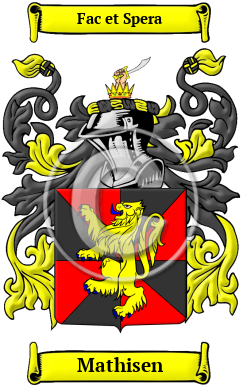
The motto was originally a war cry or slogan. Mottoes first began to be shown with arms in the 14th and 15th centuries, but were not in general use until the 17th century. Thus the oldest coats of arms generally do not include a motto. Mottoes seldom form part of the grant of arms: Under most heraldic authorities, a motto is an optional component of the coat of arms, and can be added to or changed at will; many families have chosen not to display a motto.
Motto: Fac et Spera
Motto Translation: Do and hope.
- Lower, Mark Anthony, Patronymica Britannica, A Dictionary of Family Names of the United Kingdom. London: John Russel Smith, 1860. Print.
- Smith, Eldson Coles, New Dictionary of American Family Names New York: Harper & Row, 1956. Print
- Black, George F., The Surnames of Scotland Their Origin, Meaning and History. New York: New York Public Library, 1946. Print. (ISBN 0-87104-172-3)
 |