| ![Show Contents]() Mascal History, Family Crest & Coats of Arms Mascal History, Family Crest & Coats of Arms
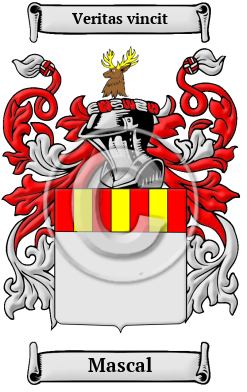
Etymology of MascalWhat does the name Mascal mean? The Pictish clans of ancient Scotland were the ancestors of first people to use the name Mascal. The name was found in the lands of Keith in the county of East Lothian. Traditionally the Keiths were descended from Robert, an early Chieftain of the Catti tribe, and possibly one of the earliest settlers in Scotland. Robert joined King Malcolm II at the battle of Panbridge, in 1006, against Camus, leader of the Danes. Robert slew Camus for which King Malcolm granted Robert the hereditary title of Marshall of Scotland, with a barony in Lothian and the island of Inskeith in the gulf of Edinburgh. It is for this title that the Keiths are sometimes known as the Marshalls, and many Clansmen adopted that name. Mascal Coat of Arms CreationThe significance of the Mascal Coat of Arms is most interesting. On the chief (top portion) of the shield, there are red and gold lines which divide it into compartments. This distinction is said to have been awarded to a Robert Keith by Malcolm II. of Scotland. This Robert at the Battle of Panbride in 1006 helped the King win a notable victory over the Danes by slewing the Danish King Camus. Malcolm dipped his fingers in the vanquished King's blood, and drew strokes with it on the top of Robert Keith's shield. These red lines remain to this day. The Keiths were hereditary Marischals of Scotland, and for this share in the preservation of the regalia of Scotland, that a later Keith was made Earl of Kintore in 1677. He was proprietor of Dunottar Castle, in which the regalia was concealed. 1 Early Origins of the Mascal familyThe surname Mascal was first found in Haddingtonshire where Harvey Keith, successor of the aforementioned Robert Keith (d. 1346) inherited the office of Marshal late in the 13th century, but was imprisoned by the English until 1304. "Reported to [King] Edward as 'one of his worst enemies,' and 'of bad repute,' he was ordered to be removed to Nottingham Castle; but, on reaching York on his way thither, was sent to Bristol Castle. In 1302 he was admitted to the king's peace, and returning to Scotland, is mentioned as dining with the Prince of Wales at Perth in February 1304." 2 He became one of four Deputy Wardens of Scotland. He joined the cause of King Robert the Bruce, and for their assistance to the Scottish crown, the Clan was granted the royal forest of Kintore. Harvey Keith commanded the Scots Cavalry at Bannockburn and was probably more instrumental in the annihilation of the English army than any other single person. He was again granted lands for his deeds, this time at the expense of the Clan Cumming (Comyn), whose estates at Buchan were acquired by the Keith Clan. His great grandson, Sir William Keith, (d. 1336) founded the tower of Dunottar Castle. He brought the bones and heart of James Douglas, as well as King Robert I of Scotland's heart, back to Scotland after Douglas was killed on crusade in Spain. Through marriage with an heiress of the Cheynes of Axkergill, the Keiths acquired lands in Caithrless, and began a never-ending succession of feuds with their new neighbors, the Gunns and others. Early History of the Mascal familyThis web page shows only a small excerpt of our Mascal research. Another 359 words (26 lines of text) covering the years 1350, 1357, 1358, 1369, 1371, 1407, 1438, 1464, 1475, 1540, 1553, 1581, 1585, 1588, 1610, 1623, 1635, 1638, 1664, 1670, 1681, 1694, 1699, 1712, 1714, 1716, 1718, 1757, 1758 and 1890 are included under the topic Early Mascal History in all our PDF Extended History products and printed products wherever possible. Mascal Spelling VariationsIn the Middle ages, spelling and translation were not yet regulated by any general rules. spelling variations in names were common even among members of one family unit. Mascal has appeared Keith, Keath, Ceiteach (Gaelic) and others. Early Notables of the Mascal familyWilliam Keith (d. 1475), 1st Earl Marischal of Scotland; Agnes Keith, Countess of Moray (c.1540-1588), a Scottish noblewoman; William Keith, 4th Earl Marischal (d. 1581), a Scottish nobleman and politician; George Keith, 5th Earl Marischal (c.1553-1623), a Scottish nobleman; William Keith, 6th Earl Marischal (c.1585-1635), a Scottish lord, Earl Marischal and naval official; William Keith, 7th Earl Marischal (1610-1670), a Scottish nobleman...
Another 61 words (4 lines of text) are included under the topic Early Mascal Notables in all our PDF Extended History products and printed products wherever possible. Migration of the Mascal family to IrelandSome of the Mascal family moved to Ireland, but this topic is not covered in this excerpt.
Another 59 words (4 lines of text) about their life in Ireland is included in all our PDF Extended History products and printed products wherever possible. Migration of the Mascal familyFaced by this persecution and the generally unstable political climate of those days, many Scots chose to leave their homeland for Ireland, Australia, and North America in search of greater opportunity and freedom. The colonies across the Atlantic were the most popular choice, but a passage there was neither cheap nor easily suffered. Passengers arrived sick and poor, but those who made it intact often found land and more tolerant societies in which to live. These brave settlers formed the backbone of the burgeoning nations of Canada and the United States. It is only this century that the ancestors of these families have begun to recover their collective identity through the patriotic highland games and Clan societies that have sprung up throughout North America. Research into early immigration and passenger lists revealed many immigrants bearing the name Mascal: James Keith settled in Barbados with his wife and daughter in 1678; Henry Keith settled in Virginia in 1679; George Keith settled in Philadelphia in 1682.
The motto was originally a war cry or slogan. Mottoes first began to be shown with arms in the 14th and 15th centuries, but were not in general use until the 17th century. Thus the oldest coats of arms generally do not include a motto. Mottoes seldom form part of the grant of arms: Under most heraldic authorities, a motto is an optional component of the coat of arms, and can be added to or changed at will; many families have chosen not to display a motto.
Motto: Veritas vincit
Motto Translation: Truth Conquers.
- Polson, Alexander, The Romance of Scottish Crests and Mottoes. Inverness: Walter Alexander, Inglis Street 1929. Print
- Smith, George (ed), Dictionary of National Biography. London: Smith, Elder & Co., 1885-1900. Print
 |