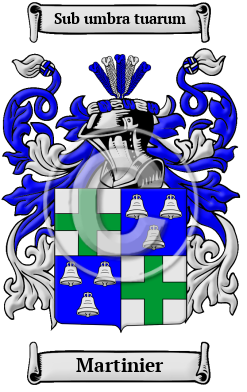
| ![Show Contents]() Martinier History, Family Crest & Coats of Arms Martinier History, Family Crest & Coats of Arms
Etymology of MartinierWhat does the name Martinier mean? Of all the French names to come from Normandy, Martinier is one of the most ancient. The name is a result of the original family having lived in Normandy. Early Origins of the Martinier familyThe surname Martinier was first found in Normandy (French: Normandie), the former Duchy of Normandy, where the family has held a family seat since early times. By 1204 a branch of the family was firmly established in Fittleton where Elyas de Martigni in Normandy gave five marks to pay tax on his lands in England. A second family of this name originated from the region of Faucigny, in the province of Savoie, then moved to Bourgogne, where they established in the region of Charollais. Among its members were: Guillaume, a "gruyer" (supervisor of lands and forests) of Charollais in 1358; another Guillaume, a Knight, who was listed in an arms display in 1419; Jean, a Knight of the Order and Lord of la Villeneuve and Rocheprise, who died in 1576; and Jean and Claude, sons of Jean, who were Horsemen in 1593. This certain family were admitted to the Estates in 1562. The last family originated from the region of Poitou. A member included in this family was: Jean, a Knight of Saint-Lazare, and spouse of Anne de Boigne, and who was a nephew of a Counselor of the Parliament of Bordeaux. Louis Martineau, born in 1632, son of Jean and Mathurine (née Bonne), travelled to Canada in the 17th century. After arriving in Quebec he married Madeleine Marcot, born in 1634, daughter of Mathurin and Marie (née Regnaud), at Château-Richer on 9th April 1663. They remained together in Quebec until Louis passed away at Saint-François-de-l'île-d'Orléans on 21st May 1709. 1 Early History of the Martinier familyThis web page shows only a small excerpt of our Martinier research. Another 75 words (5 lines of text) covering the years 1066, 1139 and 1576 are included under the topic Early Martinier History in all our PDF Extended History products and printed products wherever possible. Martinier Spelling VariationsFrench surnames were subject to numerous alterations in spelling because of the various cultural groups that inhabited specific regions. Eventually, each region possessed its own local dialect of the French language. The early development of the French language, however, was also influenced by other languages. For example, Old French was infused with Germanic words and sounds when barbarian tribes invaded and settled in France after the fall of the Roman Empire. Middle French also borrowed heavily from the Italian language during the Renaissance. As a result of these linguistic and cultural influences, the name Martinier is distinguished by a number of regional variations. The many spelling variations of the name include Martigny, Martignie, Martignies, Marrtigny, Marrtignie, Marrtignies, Martigney, Martinerie, Martinière, Martinier, Martini, Martygny, Martygnie, Martygnies, Marttigny, Marttignie, Marttignies, de Martigny, du Martigny and many more. Early Notables of the Martinier familyMore information is included under the topic Early Martinier Notables in all our PDF Extended History products and printed products wherever possible. Migration of the Martinier familyFrance was active as a cultural leader in the early 16th century. One particular area in which they lead was the exploration of the New World. The explorers, like Jacques Cartier in 1534, led the way to North America. Champlain, in 1608, made the first of twenty voyages to France to attract settlers and brought the first migrant in 1617. By 1675, there were 7000 French in Quebec, and the French Acadian presence in the Maritimes had reached 500. The French founded Lower Canada, thus becoming one of the two great founding nations of Canada. The family name Martinier has made many distinguished contributions in France and New France to the world of science, culture, religion, and education. Amongst the settlers in North America with this distinguished name Martinier were Antoine Martineau who settled in Quebec in 1758.
The motto was originally a war cry or slogan. Mottoes first began to be shown with arms in the 14th and 15th centuries, but were not in general use until the 17th century. Thus the oldest coats of arms generally do not include a motto. Mottoes seldom form part of the grant of arms: Under most heraldic authorities, a motto is an optional component of the coat of arms, and can be added to or changed at will; many families have chosen not to display a motto.
Motto: Sub umbra tuarum
Motto Translation: I will rest under a shadow.
- Olivier, Reginald L. Your Ancient Canadian Family Ties. Logan: The Everton Publishers, Inc., P.O. Box 368, 1972. Print
 |