| ![Show Contents]() Manry History, Family Crest & Coats of Arms Manry History, Family Crest & Coats of Arms
- Origins Available:
Scotland
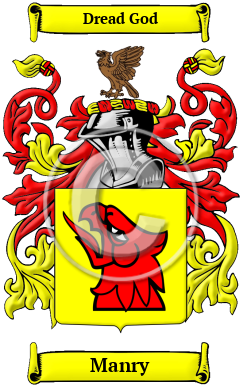
Etymology of ManryWhat does the name Manry mean? The Pictish clans of ancient Scotland were the ancestors of the first people to use the name Manry. It comes from near the foot of the river Roe in the Irish county of Derry. The Gaelic form of the name is Rothach, which means a man of Ro or a man from Ro. Manry Coat of Arms CreationThis is one of the oldest, most highly esteemed, and famous of the Highland clans. The crest of the Munroes is an eagle perching, with eagles as supporters, and the motto is " Dread God." The eagle is regarded as the king of birds and the emblem of magnanimity and fortitude of mind, and is cer-tainly applicable to the Munroes. Ben Wyvis, which was the property of the Munroes in the olden time was a home of eagles, and the club moss, the badge of the Munroes, is also found in abundance on this mountain. There is an eagle stone at Strathpeffer, and it is supposed to be in memory of some clan fight in which Munro was successful. It is worth noting-that in a charter which the Munroes got, they were declared to hold their lands on condition of their furnishing, even at midsummer, a ball of snow, if required. This could always easily be done. Afterwards the condition of tenure was a pair of white gloves or three pence. 1 Early Origins of the Manry familyThe surname Manry was first found in Cromartyshire, where they were descended from Donadl O'Kane and his Irish sept, who left their homeland at the mouth of the river Roe, in Ireland and settler in Ferrindonald in Cromarty, in the 11th century. Other historians suggest the name was originally Monrosse, because they were Mountaineers of Ross. In this case, their traditional origin is from the Siol O'Cain, an ancient Pictish tribe descended from Anselan O'Cain in North Moray, which also produced the Buchanans and the MacMillans. Early History of the Manry familyThis web page shows only a small excerpt of our Manry research. Another 419 words (30 lines of text) covering the years 1210, 1230, 1476, 1505, 1602, 1651, 1680, 1693, 1697, 1719 and 1729 are included under the topic Early Manry History in all our PDF Extended History products and printed products wherever possible. Manry Spelling VariationsTranslation has done much to alter the appearance of many Scottish names. It was a haphazard process that lacked a basic system of rules. Spelling variations were a common result of this process. Manry has appeared Monroe, Monro, Monrow, Munroe, Munro, Munrow and many more. Early Notables of the Manry familySir William Munro of Foulis (died 1505), a Scottish Knight and Scottish Clan chief of the highland Clan Munro, by tradition the 12th Baron of Foulis and 15th overall chief of the clan; Robert Monro of the Munro of Obsdale family (died 1680), a famous Scottish General, from the Clan Munro of Ross-shire; Sir George Munro, 1st Baronet of Newmore (1602-1693), Scottish soldier and Member of Parliament; Sir John Munro, 4th Baronet of Foulis (died 1697), 22nd Baron and 25th chief of the Clan Munro; Sir Robert Munro, 5th Baronet of Foulis (died 1729), the 23rd Baron and 26th chief of...
Another 120 words (9 lines of text) are included under the topic Early Manry Notables in all our PDF Extended History products and printed products wherever possible. Migration of the Manry familyMany Scots left their country to travel to the North American colonies in search of the freedom they could not find at home. Of those who survived the difficult voyage, many found the freedom they so desired. There they could choose their own beliefs and allegiances. Some became United Empire Loyalists and others fought in the American War of Independence. The Clan societies and highland games that have sprung up in the last century have allowed many of these disparate Scots to recover their collective national identity. A search of immigration and passenger ship lists revealed many early settlers bearing the Manry name: Alexander Monro, who settled in Georgia in 1735 with his wife and children; Hector Monroe settled in Barbados in 1745; Hugh Monrow settled in Boston in 1651.
| Contemporary Notables of the name Manry (post 1700) | + |
- Robert Neal Manry (1918-1971), American copy editor for the Cleveland Plain Dealer who in 1965 sailed from Falmouth, Massachusetts, to Falmouth, Cornwall, England in a tiny 13.5-foot (4.1 m) sailboat named Tinkerbelle; the voyage lasted 78 days
- Charles P. Manry, American politician, Mayor of Bozeman, Montana, 1907-09, 1911-12; Resigned 1912 2
- Charles Casimir Manry (1823-1866), French composer and choral conductor
| Manry Motto and War Cry | + |
The motto was originally a war cry or slogan. Mottoes first began to be shown with arms in the 14th and 15th centuries, but were not in general use until the 17th century. Thus the oldest coats of arms generally do not include a motto. Mottoes seldom form part of the grant of arms: Under most heraldic authorities, a motto is an optional component of the coat of arms, and can be added to or changed at will; many families have chosen not to display a motto.
Motto: Dread God
War Cry: " Caisteal Foulis na theMe "
War Cry Description: (Foulis Castle on fire).
- Polson, Alexander, The Romance of Scottish Crests and Mottoes. Inverness: Walter Alexander, Inglis Street 1929. Print
- The Political Graveyard: Alphabetical Name Index. (Retrieved 2015, October 26) . Retrieved from http://politicalgraveyard.com/alpha/index.html
 |