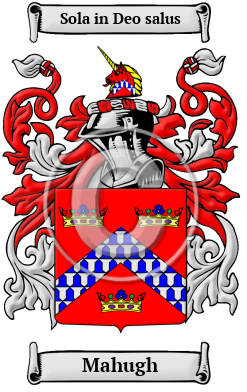
| ![Show Contents]() Mahugh History, Family Crest & Coats of Arms Mahugh History, Family Crest & Coats of Arms
- Origins Available:
England
France
Etymology of MahughWhat does the name Mahugh mean? Mahugh is a name that came to England in the 11th century wave of migration that was set off by the Norman Conquest of 1066. The Mahugh family lived in Norfolk. Their name, however, derives from the family's place of residence prior to the Norman Conquest of England in 1066, Mayeux, Normandy. 1 Alternatively the name could have been "an Anglo-French form of Matthew." 2 3 4 Early Origins of the Mahugh familyThe surname Mahugh was first found in Berkshire where Geoffrey Maheu was listed c. 1240. A few years later, William Mahu was recorded in the Subsidy Rolls for Sussex in 1296 and William Mayhew was found in Colchester in 1351. Later again, John Mayho was recorded in Kent in 1428 and John Mayhow and William Mayo were both listed in the Subsidy Rolls for Suffolk in 1524. 5 Early History of the Mahugh familyThis web page shows only a small excerpt of our Mahugh research. Another 92 words (7 lines of text) covering the years 1569, 1593, 1600, 1621, 1625, 1631, 1642, 1644, 1673, 1681, 1682, 1696, 1697, 1700, 1710 and 1758 are included under the topic Early Mahugh History in all our PDF Extended History products and printed products wherever possible. Mahugh Spelling VariationsThe English language only became standardized in the last few centuries. For that reason, spelling variations are common among many Anglo-Norman names. The shape of the English language was frequently changed with the introduction of elements of Norman French, Latin, and other European languages; even the spelling of literate people's names were subsequently modified. Mahugh has been recorded under many different variations, including Mayhew, Mahewe, Mahugh, Mayhugh, Mayhuys, Mayhue and others. Early Notables of the Mahugh familyEdward Mayhew (1569-1625), an English Benedictine. His family was Mayhew or Mayow from Winton, near Salisbury, Wiltshire.
Governor Thomas Mayhew, the Elder (1593-1682) established the first European settlement in Martha's Vineyard, Nantucket and adjacent islands in 1642. He is one of the editors of the Bay Psalm Book, the first book published in the Thirteen Colonies. He was born in Tisbury, Wiltshire in England and married Anna (also called Hanna and Abigail) Parkhurst, born about 1600, in Hampshire, England. In 1621 they had a son, Thomas, the Younger, baptised in Hanna's home town of Southampton. Two years later they had another...
Another 188 words (13 lines of text) are included under the topic Early Mahugh Notables in all our PDF Extended History products and printed products wherever possible. Migration of the Mahugh familyTo escape the uncertainty of the political and religious uncertainty found in England, many English families boarded ships at great expense to sail for the colonies held by Britain. The passages were expensive, though, and the boats were unsafe, overcrowded, and ridden with disease. Those who were hardy and lucky enough to make the passage intact were rewarded with land, opportunity, and social environment less prone to religious and political persecution. Many of these families went on to be important contributors to the young nations of Canada and the United States where they settled. Mahughs were some of the first of the immigrants to arrive in North America: Thomas Mayhew, who settled in Salem with his wife in 1630; and John Mayhew, who settled in Rappahannock in 1727.
The motto was originally a war cry or slogan. Mottoes first began to be shown with arms in the 14th and 15th centuries, but were not in general use until the 17th century. Thus the oldest coats of arms generally do not include a motto. Mottoes seldom form part of the grant of arms: Under most heraldic authorities, a motto is an optional component of the coat of arms, and can be added to or changed at will; many families have chosen not to display a motto.
Motto: Sola in Deo salus
Motto Translation: Safety in God alone.
- The Norman People and Their Existing Descendants in the British Dominions and the United States Of America. Baltimore: Genealogical Publishing, 1975. Print. (ISBN 0-8063-0636-X)
- Harrison, Henry, Surnames of the United Kingdom: A Concise Etymological Dictionary Baltimore: Geneological Publishing Company, 2013. Print
- Barber, Henry, British Family Names London: Elliot Stock, 62 Paternoster Row, 1894. Print.
- Lower, Mark Anthony, Patronymica Britannica, A Dictionary of Family Names of the United Kingdom. London: John Russel Smith, 1860. Print.
- Reaney, P.H and R.M. Wilson, A Dictionary of English Surnames. London: Routledge, 1991. Print. (ISBN 0-415-05737-X)
 |