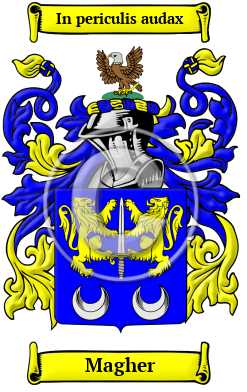
| ![Show Contents]() Magher History, Family Crest & Coats of Arms Magher History, Family Crest & Coats of Arms
- Origins Available:
Ireland
Etymology of MagherWhat does the name Magher mean? While many Irish names are familiar, their past incarnations are often shrouded in mystery, reflecting the ancient Gaelic heritage of their bearers. The original Gaelic form of the name Magher is Ó Meachair, derived from the word "michair," which means "hospitable" or "kindly." 1 Early Origins of the Magher familyThe surname Magher was first found in County Tipperary (Irish: Thiobraid Árann), established in the 13th century in South-central Ireland, in the province of Munster, where they traditionally belong to the barony of Ikerrin. The family has retained this area as their homestead as over 50% of them come from here. 2 "The O'Meaghers were formerly powerful Chiefs possessing the Barony of Ikerrin, in County Tipperary, of which O'Meagher was Lord. The Meaghers or Mahers are principally found in County Tipperary at present." 3 Early History of the Magher familyThis web page shows only a small excerpt of our Magher research. Another 119 words (8 lines of text) covering the years 1172, 1551, 1635 and 1705 are included under the topic Early Magher History in all our PDF Extended History products and printed products wherever possible. Magher Spelling VariationsLacking standardized spellings, scribes and church officials recorded people's name according to how they sounded. This practice often led to the misleading result of one person's name being recorded under several different spellings. Numerous spelling variations of the surname Magher are preserved in the archival documents of the period. The various spellings of the name that were found include Maher, O'Meagher, Meagher, O'Maher, Mahir and others. Early Notables of the Magher familyMore information is included under the topic Early Magher Notables in all our PDF Extended History products and printed products wherever possible.
| Magher migration to the United States | + |
Under the rule of England, land ownership in Ireland changed dramatically, and many native Irish families found themselves renting out land to farm from absentee owners. This was one of the prime reasons that immigration to North America began in the late 18th century: Irish farmers dreamed of owning their own parcel of land to work for themselves. At this point, the immigrants were at least of modest means for the passage across the Atlantic was often quite dear. In the 1840s the Great Potato Famine created an exodus of people of quite different means. These people were most often destitute: they either sold anything they had to gain a passage or they were sponsored by philanthropic societies. Many of these immigrants were sick from disease and starvation: as a result many did not survive the long transatlantic journey. Although those settlers that did survive were often despised and discriminated against by people already established in these nations, they were critical to rapid development of the powerful industrial nations of the United States and the country that would later become known as Canada. An examination of immigration and passenger lists shows many persons bearing the name of Magher or one of its variants:
Magher Settlers in United States in the 17th Century- Teig Magher, who landed in Maryland in 1678 4
Magher Settlers in United States in the 19th Century- Miss Mary Magher, aged 28, Irish settler who arrived in New York in 1846 aboard the ship "Stephen Whitney"
- Richard Magher, who landed in Allegany (Allegheny) County, Pennsylvania in 1852 4
| Magher migration to Canada | + |
Magher Settlers in Canada in the 19th Century- Margaret Magher, who landed in Nova Scotia in 1830
- John Magher, who arrived in Nova Scotia in 1831
- Thomas Magher, who arrived in Nova Scotia in 1831
- Thomas Magher, who landed in Nova Scotia in 1832
- Honors Magher, who arrived in Nova Scotia in 1832
- ... (More are available in all our PDF Extended History products and printed products wherever possible.)
| Magher migration to Australia | + |
Magher Settlers in Australia in the 19th Century- Catherine Magher, aged 20, a domestic servant, who arrived in South Australia in 1855 aboard the ship "Aliquis"
- Miss May Magher, (b. 1843), aged 20, Irish settler travelling from Queenstown, Ireland aboard the ship "Golden Empire" arriving in Brisbane, Australia in July 1863 5
- Miss Kate Magher, (b. 1845), aged 18, Irish settler travelling from Queenstown, Ireland aboard the ship "Golden Empire" arriving in Brisbane, Australia in July 1863 5
| Magher migration to New Zealand | + |
Emigration to New Zealand followed in the footsteps of the European explorers, such as Captain Cook (1769-70): first came sealers, whalers, missionaries, and traders. By 1838, the British New Zealand Company had begun buying land from the Maori tribes, and selling it to settlers, and, after the Treaty of Waitangi in 1840, many British families set out on the arduous six month journey from Britain to Aotearoa to start a new life. Early immigrants include: Magher Settlers in New Zealand in the 19th Century- Miss Margaret Magher, (b. 1860), aged Infant, Irish settler from County Cork travelling from Bristol aboard the ship "William Miles" arriving in Lyttelton, Christchurch, South Island, New Zealand on 21st August 1860 6
- Mrs. Magher, (b. 1833), aged 27, Irish settler from County Cork travelling from Bristol aboard the ship "William Miles" arriving in Lyttelton, Christchurch, South Island, New Zealand on 21st August 1860 6
- Mr. Patrick Magher, (b. 1833), aged 27, Irish shepherd from County Cork travelling from Bristol aboard the ship "William Miles" arriving in Lyttelton, Christchurch, South Island, New Zealand on 21st August 1860 6
- Miss Sarah Magher, (b. 1849), aged 11, Irish settler from County Cork travelling from Bristol aboard the ship "William Miles" arriving in Lyttelton, Christchurch, South Island, New Zealand on 21st August 1860 6
- Mr. Michael Magher, (b. 1851), aged 9, Irish settler from County Cork travelling from Bristol aboard the ship "William Miles" arriving in Lyttelton, Christchurch, South Island, New Zealand on 21st August 1860 6
- ... (More are available in all our PDF Extended History products and printed products wherever possible.)
The motto was originally a war cry or slogan. Mottoes first began to be shown with arms in the 14th and 15th centuries, but were not in general use until the 17th century. Thus the oldest coats of arms generally do not include a motto. Mottoes seldom form part of the grant of arms: Under most heraldic authorities, a motto is an optional component of the coat of arms, and can be added to or changed at will; many families have chosen not to display a motto.
Motto: In periculis audax
Motto Translation: Bold in danger
- MacLysaght, Edward, The Surnames of Ireland. Ireland: Irish Academic Press, sixth edition, 1985. Print. (ISBN 0-7165-2366-3)
- MacLysaght, Edward, Irish Families Their Names, Arms and Origins 4th Edition. Dublin: Irish Academic, 1982. Print. (ISBN 0-7165-2364-7)
- Matheson, Robert E., Special Report on Surnames in Ireland with Notes as to Numeric Strength, Derivation, Ethnology, and Distribution. Dublin: Alexander Thom & Co., 1894. Print
- Filby, P. William, Meyer, Mary K., Passenger and immigration lists index : a guide to published arrival records of about 500,000 passengers who came to the United States and Canada in the seventeenth, eighteenth, and nineteenth centuries. 1982-1985 Cumulated Supplements in Four Volumes Detroit, Mich. : Gale Research Co., 1985, Print (ISBN 0-8103-1795-8)
- The Ships List Passenger Lists Ship Golden Empire (Retrieved 26th October 2018). Retrieved from http://www.ozlists.com/genies/shipping/special_lists/s_golden_empire.htm
- New Zealand Yesteryears Passenger Lists 1800 to 1900 (Retrieved 26th March 2019). Retrieved from http://www.yesteryears.co.nz/shipping/passlist.html
 |