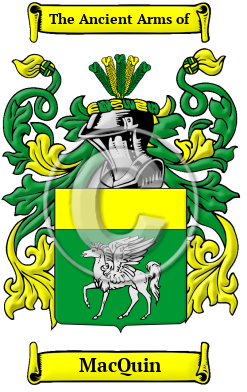
| ![Show Contents]() MacQuin History, Family Crest & Coats of Arms MacQuin History, Family Crest & Coats of Arms
Etymology of MacQuinWhat does the name MacQuin mean? The Irish name MacQuin was originally written in a Gaelic form as Ó Cuinn, which means descendant of Conn. Early Origins of the MacQuin familyThe surname MacQuin was first found in county Longford (Irish: An Longfort) traditionally known as Annaly or Teffia, and situated in the Irish Midlands, in Northwest Leinster where they were Lords of Muintir Gillagain. The O'Quinns and MacQuinns (and all of the spelling variables derived from these) were descended from Conn, who in turn was descended from the Princes of Annaly. Early History of the MacQuin familyThis web page shows only a small excerpt of our MacQuin research. Another 144 words (10 lines of text) covering the years 1014, 1252, 1279, 1281, 1522, 1551, 1575, 1595, 1634, 1645, 1676, 1693, 1726 and 1766 are included under the topic Early MacQuin History in all our PDF Extended History products and printed products wherever possible. MacQuin Spelling VariationsMany spelling variations of the surname MacQuin can be found in the archives. One reason for these variations is that ancient scribes and church officials recorded names as they were pronounced, often resulting in a single person being recorded under several different spellings. The different spellings that were found include O'Quinn, Quin, Quinn, Quine, MacQuin, MacQuinn, McQuin, McQuinn, MacCuin, Cuinn, Cuin and many more. Early Notables of the MacQuin familyThomas O'Quinn, Bishop of Clonmacnois (1252-1279), as well as John Quinn, Bishop of Limerick (1522-1551), as well as Thady Quin (1645-1726) of Adare of the Thomond O'Quins, who was the grandfather of the first Earl of Dunraven.
Walter Quin (c. 1575-1634), was an Irish poet and preceptor of Charles I. Born in Dublin, he travelled abroad and became a cultivated writer in English, French, Italian, and Latin. He was in Edinburgh when, in 1595, he...
Another 73 words (5 lines of text) are included under the topic Early MacQuin Notables in all our PDF Extended History products and printed products wherever possible.
| MacQuin migration to Australia | + |
MacQuin Settlers in Australia in the 19th Century- Mr. Maurice Vincent MacQuin, English convict who was convicted in Liverpool, Merseyside, England for life, transported aboard the "Blundell" on 13th March 1844, arriving in Tasmania (Van Diemen's Land) 1
| MacQuin migration to West Indies | + |
The British first settled the British West Indies around 1604. They made many attempts but failed in some to establish settlements on the Islands including Saint Lucia and Grenada. By 1627 they had managed to establish settlements on St. Kitts (St. Christopher) and Barbados, but by 1641 the Spanish had moved in and destroyed some of these including those at Providence Island. The British continued to expand the settlements including setting the First Federation in the British West Indies by 1674; some of the islands include Barbados, Bermuda, Cayman Island, Turks and Caicos, Jamaica and Belize then known as British Honduras. By the 1960's many of the islands became independent after the West Indies Federation which existed from 1958 to 1962 failed due to internal political conflicts. After this a number of Eastern Caribbean islands formed a free association. 2MacQuin Settlers in West Indies in the 17th Century- Daniel Macquin, aged 21, who landed in Antigua (Antego) in 1683 3
- Convict Records Voyages to Australia (Retrieved 25th October 2020). Retrieved from https://convictrecords.com.au/ships/blundell
- https://en.wikipedia.org/wiki/British_West_Indies
- Filby, P. William, Meyer, Mary K., Passenger and immigration lists index : a guide to published arrival records of about 500,000 passengers who came to the United States and Canada in the seventeenth, eighteenth, and nineteenth centuries. 1982-1985 Cumulated Supplements in Four Volumes Detroit, Mich. : Gale Research Co., 1985, Print (ISBN 0-8103-1795-8)
 |