| ![Show Contents]() MacKlins History, Family Crest & Coats of Arms MacKlins History, Family Crest & Coats of Arms
Etymology of MacKlinsWhat does the name MacKlins mean? There are many Irish surnames being used today in forms that are quite different than their original, ancient forms. MacKlins originally appeared in Gaelic as Mac Lochlainn or Ó Maoilsheachlainn. The first name is derived from a Norse personal name, while the second name originally designated a follower of St. Secundinus. Early Origins of the MacKlins familyThe surname MacKlins was first found in County Meath (Irish: An Mhí) anciently part of the kingdom of Brega, located in Eastern Ireland, in the province of Leinster, where they held a family seat from very ancient times, long before the Norman Conquest of England in 1066 A.D. Muircheartach Mac Lochlainn (died 1166), was king of Tír Eoghain, and High King of Ireland (c.1156-1166.) Together with sixteen of his closest allies, he was killed and was succeeded by Ruaidrí Ua Conchobair. Niall Mac Lochlainn (died 1176) was a king of Cenél nEógain and Cenél Conaill, son of Muirchertach Mac Lochlainn. Early History of the MacKlins familyThis web page shows only a small excerpt of our MacKlins research. Another 68 words (5 lines of text) covering the years 1002, 1172, 1387, 1404, 1405, 1506, 1699, 1784, 1797 and 1857 are included under the topic Early MacKlins History in all our PDF Extended History products and printed products wherever possible. MacKlins Spelling VariationsPeople who were accounted for by scribes and church officials often had their name recorded many different ways because pronunciation was the only guide those scribes and church officials had to go by. This resulted in the problem of one person's name being recorded under several different variations, creating the illusion of more than one person. Among the many spelling variations of the surname MacKlins that are preserved in archival documents are MacLoughlin, McLoughlin, MacGloughlin, Lochlain, Claughan and many more. Early Notables of the MacKlins familyCearbhall mac Lochlainn Ó Dálaigh (died 1404), an Irish poet, Chief Ollam of Ireland (1387-1405); Paidin mac Lochlainn Ó Mailchonaire (died 1506), an Irish poet; Charles Macklin (1699-1797), originally Cathal MacLochlainn in Irish, or Charles McLaughlin in English, an Irish actor and dramatist born in...
Another 45 words (3 lines of text) are included under the topic Early MacKlins Notables in all our PDF Extended History products and printed products wherever possible. Migration of the MacKlins familyIrish families left their homeland in astonishing numbers during the 19th century in search of a better life. Although individual reasons vary, most of these Irish families suffered from extreme poverty, lack of work opportunities, and exorbitant rents in their homeland. Many decided to travel to Australia or North America in the hopes of finding greater opportunities and land. The Irish immigrants that came to North America initially settled on the East Coast, often in major centers such as Boston or New York. But like the many other cultures to settle in North America, the Irish traveled to almost any region they felt held greater promise; as a result, many Irish with gold fever moved all the way out to the Pacific coast. Others before that time left for land along the St. Lawrence River and the Niagara Peninsula, or the Maritimes as United Empire Loyalists, for many Irish did choose to side with the English during the American War of Independence. The earliest wave of Irish migration, however, occurred during the Great Potato Famine of the 1840s. An examination of early immigration and passenger lists has revealed many people bearing the MacKlins name: Thomas, Bridget, Catherine and Helen MacLoughlin who settled in Quebec in 1849; Bernard, Charles, Denis, Hugh, James, John, Michael, Patrick, Thomas and William MacLoughlin all arrived in Philadelphia between 1823 and 1860. The family also settled in Newfoundland between 1792 and 1872..
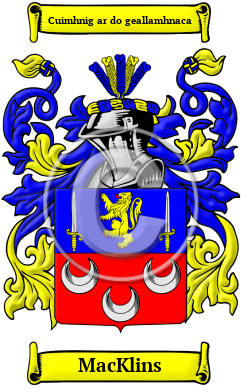
The motto was originally a war cry or slogan. Mottoes first began to be shown with arms in the 14th and 15th centuries, but were not in general use until the 17th century. Thus the oldest coats of arms generally do not include a motto. Mottoes seldom form part of the grant of arms: Under most heraldic authorities, a motto is an optional component of the coat of arms, and can be added to or changed at will; many families have chosen not to display a motto.
Motto: Cuimhnig ar do geallamhnaca
 |