| ![Show Contents]() MacKinstry History, Family Crest & Coats of Arms MacKinstry History, Family Crest & Coats of Arms
- Origins Available:
Scotland
Ireland
Etymology of MacKinstryWhat does the name MacKinstry mean? The ancient Dalriadan clans of Scotland spawned the name MacKinstry. It is derived from the personal name Simon, or from Sim, which is a diminutive form of that name. The Gaelic forms of the name are Mac Shim, meaning son of Sim. or Mac Shimidh, meaning son of Simon. Early Origins of the MacKinstry familyThe surname MacKinstry was first found in the Isle of Bute, in western Scotland where they held lands anciently granted by the King of Scotland. Early History of the MacKinstry familyThis web page shows only a small excerpt of our MacKinstry research. Another 210 words (15 lines of text) covering the years 1333, 1506, 1529, 1539, 1542, 1550, 1586, 1609, 1641 and 1890 are included under the topic Early MacKinstry History in all our PDF Extended History products and printed products wherever possible. MacKinstry Spelling VariationsIn the Middle Ages, the translation between Gaelic and English was not a highly developed process. Spelling was not yet standardized, and so, an enormous number of spelling variations appear in records of early Scottish names. MacKinstry has appeared as M'Shimis, M'Shimmie, M'Kimmie, M'Kim, M'Kym, M'Kymme, M'Shiomoun, M'Kin and many more. Early Notables of the MacKinstry familyMore information is included under the topic Early MacKinstry Notables in all our PDF Extended History products and printed products wherever possible. Migration of the MacKinstry family to IrelandSome of the MacKinstry family moved to Ireland, but this topic is not covered in this excerpt.
Another 60 words (4 lines of text) about their life in Ireland is included in all our PDF Extended History products and printed products wherever possible.
| MacKinstry migration to the United States | + |
Many settled along the east coast of what would become the United States and Canada. As the American War of Independence broke out, those who remained loyal to the crown went north to Canada as United Empire Loyalists. The ancestors of all of these hardy Dalriadan-Scottish settlers began to recover their collective history in the 20th century with the advent of the vibrant culture fostered by highland games and Clan societies in North America. Highland games, Clan societies, and other organizations generated much renewed interest in Scottish heritage in the 20th century. The MacKinstry were among the earliest of the Scottish settlers as immigration passenger lists have shown:
MacKinstry Settlers in United States in the 19th Century- John MacKinstry, who arrived in New York, NY in 1816 1
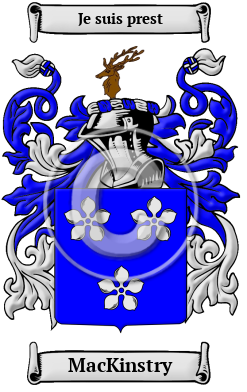
The motto was originally a war cry or slogan. Mottoes first began to be shown with arms in the 14th and 15th centuries, but were not in general use until the 17th century. Thus the oldest coats of arms generally do not include a motto. Mottoes seldom form part of the grant of arms: Under most heraldic authorities, a motto is an optional component of the coat of arms, and can be added to or changed at will; many families have chosen not to display a motto.
Motto: Je suis prest
Motto Translation: I am ready.
- Filby, P. William, Meyer, Mary K., Passenger and immigration lists index : a guide to published arrival records of about 500,000 passengers who came to the United States and Canada in the seventeenth, eighteenth, and nineteenth centuries. 1982-1985 Cumulated Supplements in Four Volumes Detroit, Mich. : Gale Research Co., 1985, Print (ISBN 0-8103-1795-8)
 |