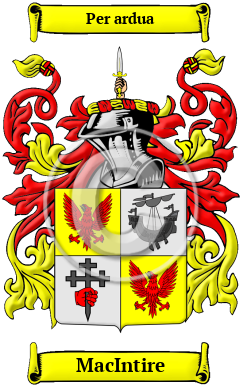
| ![Show Contents]() MacIntire History, Family Crest & Coats of Arms MacIntire History, Family Crest & Coats of Arms
- Origins Available:
Scotland
Ireland
Etymology of MacIntireWhat does the name MacIntire mean? The ancestors of the name MacIntire are thought to have come from the ancient Scottish kingdom of Dalriada. MacIntire was used to indicate someone who worked as a carpenter or wright. The Gaelic form Mac an t-saoir means son of the carpenter. Most historians agree that their earliest habitations were on MacDonald territories on Kintyre. Most legends about their beginnings point to an origin in the Hebrides. From this point on, opinions differ. One legend has the Clan-an-t-Saor (Children of the Carpenter) arriving in Lorne in a galley with a white cow, another says that the galley, set adrift, developed a leak below the water line and the MacDonald Chieftain placed his thumb in the hole to keep the boat afloat. Spotting help at a distance, he cut off his thumb so that he could wave. He was ironically named the Carpenter or MacIntyre. Some claim that the family derived its name from a member of the MacDonalds who was called Cean-tire because of his ownership of lands on the peninsula of Kintyre. MacIntire Coat of Arms CreationThe crest of this clan is a hand holding a dagger, and their motto, " Per Ardua" (Through difficulties), probably because they had success only by hard work. There are two legends as to how they got the name Macintyre. One is that at Creich, in Sutherland, one of the Clan Donald built a fort so well that he became known as "An Saor," Gaelic for "the carpenter," and his son as "Mac-an-shaor," which is pronounced very like Macintyre. The other story is that in coming over from Ireland the plug in the bottom of the boat was displaced and thrown overboard as they were baling. Having nothing handy to stop the in rushing water, the first Macintyre thrust his thumb into the hole, and when he found that his services were urgently needed in another part of the boat, he chopped it off, and the thumbless one was afterwards known as "An Saor." Perhaps it is to commemorate this that they have a galley with sails furled in their armorial bearings. 1 Early Origins of the MacIntire familyThe surname MacIntire was first found in Argyllshire (Gaelic erra Ghaidheal), the region of western Scotland corresponding roughly with the ancient Kingdom of Dál Riata, in the Strathclyde region of Scotland, now part of the Council Area of Argyll and Bute, where according legend, Maurice or Murdock, The Wright, (c.1150) became the first MacIntyre chief as a reward for helping his uncle, Somerled, King of Argyll and the Western Isles. Early History of the MacIntire familyThis web page shows only a small excerpt of our MacIntire research. Another 181 words (13 lines of text) covering the years 1543, 1597, 1890, 1955 and 1991 are included under the topic Early MacIntire History in all our PDF Extended History products and printed products wherever possible. MacIntire Spelling VariationsIn the Middle Ages, the translation between Gaelic and English was not a highly developed process. Spelling was not yet standardized, and so, an enormous number of spelling variations appear in records of early Scottish names. MacIntire has appeared as MacIntyre, MacIntire, MacIntre and many more. Early Notables of the MacIntire familyAnother 50 words (4 lines of text) are included under the topic Early MacIntire Notables in all our PDF Extended History products and printed products wherever possible. Migration of the MacIntire family to IrelandSome of the MacIntire family moved to Ireland, but this topic is not covered in this excerpt.
Another 59 words (4 lines of text) about their life in Ireland is included in all our PDF Extended History products and printed products wherever possible.
| MacIntire migration to the United States | + |
Many of the ancestors of Dalriadan families who arrived in North America still live in communities along the east coast of Canada and the United States. In the American War of Independence many of the original settlers traveled north to Canada as United Empire Loyalists. In the late 19th and early 20th centuries the ancestors of many Scots began recovering their collective national heritage through Clan societies, highland games, and other patriotic events. Research into the origins of individual families in North America revealed records of the immigration of a number of people bearing the name MacIntire or a variant listed above:
MacIntire Settlers in United States in the 18th Century- Finloe MacIntire, who arrived in Maryland in 1716 2
- Hugh Macintire, who landed in Maryland in 1716 2
- John Macintire, who landed in Maryland in 1716 2
- John MacIntire, who arrived in Maryland in 1716 2
- Archi Macintire, who landed in Maryland in 1747 2
- ... (More are available in all our PDF Extended History products and printed products wherever possible.)
MacIntire Settlers in United States in the 19th Century- Samuel Macintire, who landed in New York, NY in 1815 2
- Robert Macintire, who landed in New York, NY in 1815 2
- James MacIntire, who landed in New York, NY in 1815 2
- James Macintire, who arrived in New York, NY in 1815 2
- Robert MacIntire, who landed in New York, NY in 1816 2
| MacIntire migration to Canada | + |
MacIntire Settlers in Canada in the 19th Century- Susannah Campbell MacIntire, who landed in Nova Scotia in 1840
| MacIntire migration to Australia | + |
MacIntire Settlers in Australia in the 19th Century- John Macintire, English convict from Middlesex, who was transported aboard the "Albion" on September 21, 1826, settling in New South Wales, Australia 3
| Contemporary Notables of the name MacIntire (post 1700) | + |
- Walter S. MacIntire, American politician, Prohibition Candidate for U.S. Representative from Connecticut, 1905, 1906 4
The motto was originally a war cry or slogan. Mottoes first began to be shown with arms in the 14th and 15th centuries, but were not in general use until the 17th century. Thus the oldest coats of arms generally do not include a motto. Mottoes seldom form part of the grant of arms: Under most heraldic authorities, a motto is an optional component of the coat of arms, and can be added to or changed at will; many families have chosen not to display a motto.
Motto: Per ardua
Motto Translation: Through difficulties.
- Polson, Alexander, The Romance of Scottish Crests and Mottoes. Inverness: Walter Alexander, Inglis Street 1929. Print
- Filby, P. William, Meyer, Mary K., Passenger and immigration lists index : a guide to published arrival records of about 500,000 passengers who came to the United States and Canada in the seventeenth, eighteenth, and nineteenth centuries. 1982-1985 Cumulated Supplements in Four Volumes Detroit, Mich. : Gale Research Co., 1985, Print (ISBN 0-8103-1795-8)
- State Library of Queensland. (Retrieved 2016, October 27) Albion voyage to New South Wales, Australia in 1826 with 192 passengers. Retrieved from http://www.convictrecords.com.au/ships/albion/1826
- The Political Graveyard: Alphabetical Name Index. (Retrieved 2016, January 15) . Retrieved from http://politicalgraveyard.com/alpha/index.html
 |