| ![Show Contents]() MacHans History, Family Crest & Coats of Arms MacHans History, Family Crest & Coats of Arms
- Origins Available:
Ireland
Wales
Etymology of MacHansWhat does the name MacHans mean? Throughout history, very few Irish surnames have exclusively maintained their original forms. Before being translated into English, MacHans appeared as Mac Cana, which is derived from the word cana, which means wolf cub. Early Origins of the MacHans familyThe surname MacHans was first found in County Armagh (Irish: Ard Mhacha) located in the province of Ulster in present day Northern Ireland, at Clanbrasil, a region on the southern shore of Lough Neagh. The family supplanted the O'Graveys at the time of Strongbow's Anglo-Norman invasion in 1172 as lords of this area and became known as the Lords of Clanbrassil. One of the earliest records of the name was Amhlaibh Mc Canna (died 1155), described by the Four Masters as "pillar of chivalry and vigour of Cinel Eoghin" 1 Early History of the MacHans familyThis web page shows only a small excerpt of our MacHans research. Another 39 words (3 lines of text) covering the years 1155, 1598 and 1718 are included under the topic Early MacHans History in all our PDF Extended History products and printed products wherever possible. MacHans Spelling VariationsThe recording of names in Ireland during the Middle Ages was an inconsistent endeavor at best. Since the general population did not know how to read or write, they could only specify how their names should be recorded orally. Research into the name MacHans revealed spelling variations, including MacCann, MacCanna, MacCan, MacAnn, MacAn and others. Early Notables of the MacHans familyAnother 45 words (3 lines of text) are included under the topic Early MacHans Notables in all our PDF Extended History products and printed products wherever possible. Migration of the MacHans familyA great mass of Ireland's native population left the island in the 19th century, seeking relief from various forms of social, religious, and economic discrimination. This Irish exodus was primarily to North America. If the migrants survived the long ocean journey, many unfortunately would find more discrimination in the colonies of British North America and the fledgling United States of America. These newly arrived Irish were, however, wanted as a cheap source of labor for the many large agricultural and industrial projects that were essential to the development of what would become two of the wealthiest nations in the western world. Early immigration and passenger lists indicate many people bearing the MacHans name: Arthur, Bernard, Charles, Edward, Francis, Henry, Hugh, James, John, Mary, Michael, Owen, Patrick, Peter, Roger, Thomas and William MacCann, who all arrived in Philadelphia between 1840 and 1860.
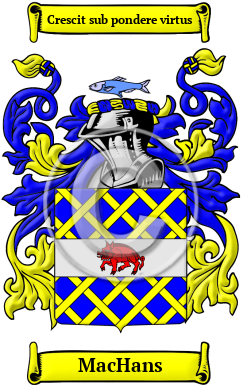
The motto was originally a war cry or slogan. Mottoes first began to be shown with arms in the 14th and 15th centuries, but were not in general use until the 17th century. Thus the oldest coats of arms generally do not include a motto. Mottoes seldom form part of the grant of arms: Under most heraldic authorities, a motto is an optional component of the coat of arms, and can be added to or changed at will; many families have chosen not to display a motto.
Motto: Crescit sub pondere virtus
Motto Translation: Virtue thrives under oppression.
- MacLysaght, Edward, Irish Families Their Names, Arms and Origins 4th Edition. Dublin: Irish Academic, 1982. Print. (ISBN 0-7165-2364-7)
 |