| ![Show Contents]() MacCart History, Family Crest & Coats of Arms MacCart History, Family Crest & Coats of Arms
- Origins Available:
Ireland
Etymology of MacCartWhat does the name MacCart mean? The Irish name MacCart was originally written in a Gaelic form as O'h-Airt, which connotes a descendant of Art. 1 Specifically, the family claim descent through "Art Eanfhear, who is number 81 on the 'Line of Heremon," and son of the Monarch Conn of the Hundred Battles." He was at times called "The Solitary," as he was the only one of his father's sons that survived; his two brothers Conla Ruadh and Crionna, having been slain by their uncles. His grief was so strong that in some writings, he was referred to as "Art, the Melancholy." (O'Hart) The name literally means "a bear, a stone; noble, great, generous; hardness." 2 Early Origins of the MacCart familyThe surname MacCart was first found in County Meath (Irish: An Mhí) anciently part of the kingdom of Brega, located in Eastern Ireland, in the province of Leinster, where they were of the southern Ui Neill. Before the Anglo-Norman invasion of the 12th century, their chiefs were known as the lords of Teffia. Early History of the MacCart familyThis web page shows only a small excerpt of our MacCart research. Another 117 words (8 lines of text) are included under the topic Early MacCart History in all our PDF Extended History products and printed products wherever possible. MacCart Spelling VariationsNames from the Middle Ages demonstrate many spelling variations. This is because the recording scribe or church official often decided as to how a person's name was spelt and in what language. Research into the name MacCart revealed many variations, including Hart, O'Hart, Harte, MacArt, McArt, MacCart, McCart and many more. Early Notables of the MacCart familyAnother 36 words (3 lines of text) are included under the topic Early MacCart Notables in all our PDF Extended History products and printed products wherever possible. Migration of the MacCart familyThousands of Irish families left for North American shores in the 19th century. These people were searching for a life unencumbered with poverty, hunger, and racial discrimination. Many arrived to eventually find such conditions, but many others simply did not arrive: victims of the diseased, overcrowded ships in which they traveled to the New World. Those who lived to see North American shores were instrumental in the development of the growing nations of Canada and the United States. A thorough examination of passenger and immigration lists has disclosed evidence of many early immigrants of the name MacCart: Daniel Hart who settled in Virginia in 1640; along with Elizabeth Hart in 1654; Henry Hart in 1637; James Hart in 1653; John Hart in 1635; Mary Hart in 1635.
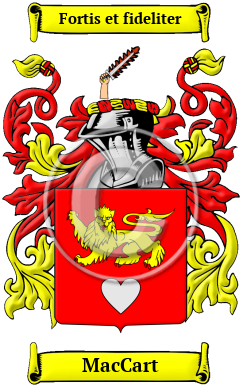
The motto was originally a war cry or slogan. Mottoes first began to be shown with arms in the 14th and 15th centuries, but were not in general use until the 17th century. Thus the oldest coats of arms generally do not include a motto. Mottoes seldom form part of the grant of arms: Under most heraldic authorities, a motto is an optional component of the coat of arms, and can be added to or changed at will; many families have chosen not to display a motto.
Motto: Fortis et fideliter
Motto Translation: Brave and faithful.
- MacLysaght, Edward, The Surnames of Ireland. Ireland: Irish Academic Press, sixth edition, 1985. Print. (ISBN 0-7165-2366-3)
- MacLysaght, Edward, Irish Families Their Names, Arms and Origins 4th Edition. Dublin: Irish Academic, 1982. Print. (ISBN 0-7165-2364-7)
 |