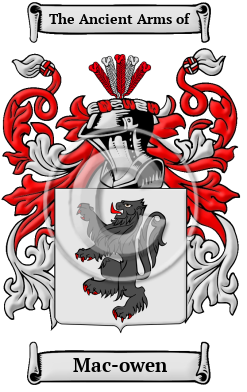
| ![Show Contents]() Mac-owen History, Family Crest & Coats of Arms Mac-owen History, Family Crest & Coats of Arms
Etymology of Mac-owenWhat does the name Mac-owen mean? A product of the ancient Brythonic Celts of Wales, the name Mac-owen, is from the Welsh personal name Owen or Owain. The Old Welsh forms of this name were Ouen and Ouein and were borrowed from the Latin name Eugenius. This is in turn derived from the Greek name Eugenios, which means well-born or noble. The name was recorded in Wales as early as 926 AD, when Uwen Wenta Cyning was noted. Early Origins of the Mac-owen familyThe surname Mac-owen was first found in Montgomeryshire (Welsh: Sir Drefaldwyn), located in mid-Eastern Wales, one of thirteen historic counties, and anciently the medieval kingdom of Powys Wenwynwyn, where they held a family seat from very ancient times, some say well before the Norman Conquest and the arrival of Duke William at Hastings in 1066 A.D. From these early beginnings, the family reached throughout early England. "George Welsh Owen, Esq. of Tiverton in Devonshire, is impropriator of the great and small tithes, both of the [parish of Egloskerry] and Tremaine, [Cornwall] which belonged formerly to the priory of Launceston. In Egloskerry there are several estates, by which no small tithes are paid. From the tithes of this parish the sum of £5 per annum is paid to the incumbent curate, and sixteen shillings to the Prince of Wales's audit." 1 Early History of the Mac-owen familyThis web page shows only a small excerpt of our Mac-owen research. Another 127 words (9 lines of text) covering the years 1169, 1600, 1608, 1616, 1622, 1624, 1639, 1640, 1645, 1647, 1659, 1661, 1664, 1666, 1676, 1678, 1679, 1683, 1692, 1698, 1700 and 1890 are included under the topic Early Mac-owen History in all our PDF Extended History products and printed products wherever possible. Mac-owen Spelling VariationsWelsh surnames are relatively few in number, but they have an inordinately large number of spelling variations. There are many factors that explain the preponderance of Welsh variants, but the earliest is found during the Middle Ages when Welsh surnames came into use. Scribes and church officials recorded names as they sounded, which often resulted in a single person's name being inconsistently recorded over his lifetime. The transliteration of Welsh names into English also accounts for many of the spelling variations: the unique Brythonic Celtic language of the Welsh had many sounds the English language was incapable of accurately reproducing. It was also common for members of a same surname to change their names slightly, in order to signify a branch loyalty within the family, a religious adherence, or even patriotic affiliations. For all of these reasons, the many spelling variations of particular Welsh names are very important. The surname Mac-owen has occasionally been spelled Owen, Owens, MacOwen, Owenson, Owenby, Ownby and others. Early Notables of the Mac-owen familyThomas Owen (died 1661), an English politician who sat in the House of Commons between 1624 and 1640, supporter of the Royalist cause in the English Civil War; Sir John Owen (1600-1666), a Welsh Royalist officer during the English Civil War; John Owen (1616-1683), an English Nonconformist church leader, theologian and administrator at the University of Oxford; Arthur Owen (ca.1608-1678), a Welsh politician who sat in the House of Commons between 1645 and 1678; Sir Hugh...
Another 75 words (5 lines of text) are included under the topic Early Mac-owen Notables in all our PDF Extended History products and printed products wherever possible. Migration of the Mac-owen family to IrelandSome of the Mac-owen family moved to Ireland, but this topic is not covered in this excerpt.
Another 59 words (4 lines of text) about their life in Ireland is included in all our PDF Extended History products and printed products wherever possible. Migration of the Mac-owen familyIn the late 19th and early 20th centuries, many people from Wales joined the general migration to North America in search of land, work, and freedom. These immigrants greatly contributed to the rapid development of the new nations of Canada and the United States. They also added a rich and lasting cultural heritage to their newly adopted societies. Investigation of immigration and passenger lists has revealed a number of people bearing the name Mac-owen: Richard Owen, who came to Virginia in 1622; Edward Owen, who settled in Virginia in 1636; Anne Owen, her husband and servants, who settled in Barbados in 1680.
- Hutchins, Fortescue, The History of Cornwall, from the Earliest Records and Traditions to the Present Time. London: William Penaluna, 1824. Print
 |